Best Iron Sights for AR Rifles in 2023 – Enhance Accuracy

Iron sights, a classic aiming tool predating modern optics, remain steadfast despite the technological advancements in firearm accessories. They embody a rich history, tracing their roots to the earliest firearms. In an age where red dot sights and scopes dominate the firearms landscape, iron sights persist as humble, yet indispensable tools.

  • For AR 15 owners, iron sights are more than just backup aids; they are a fundamental part of the firearm experience. These simple and reliable sights are ready to spring into action when other aiming systems fail. Whether your main scope is damaged, your batteries die, or you simply prefer the simplicity of iron sights, they provide a reliable aiming solution;
  • Beyond their role as backup tools, iron sights play a pivotal role in marksmanship development. Aspiring marksmen often commence their training with iron sights, honing their accuracy, discipline, and breath control over time. The deliberate process of aligning front and rear sights with the target teaches shooters to focus on the fundamentals of marksmanship. This training lays a solid foundation, fostering precision and consistency in their shooting skills.

While modern optics offer numerous advantages, iron sights hold a unique place in the hearts of firearm enthusiasts. They are a reminder of a simpler time in shooting sports, yet their practicality and effectiveness endure. In the world of firearms, where technology constantly evolves, iron sights stand as a testament to the enduring value of tried-and-true tools.

Delving into the Top 10 AR 15 Iron Sights of 2020

1. Magpul MBUS Flip-Up Backup Sights

The MBUS Flip-Up Backup Sights, renowned for their innovative design, exemplify the fusion of durability and functionality. Crafted with a polymer construction, they are purpose-built to withstand the rigors of firearm use while maintaining a lightweight profile. This combination of resilience and weight efficiency is essential for AR 15 owners who require dependable backup sights.

  • Ease of use is a hallmark of these sights. Their spring-loaded mechanism ensures quick and effortless deployment, allowing shooters to transition seamlessly from optics to iron sights when needed. This rapid response capability is particularly advantageous in dynamic shooting scenarios, where split-second decisions can make all the difference;
  • Compatibility is another key feature of the MBUS sights. Designed to fit MIL-STD-1913 Picatinny/STANAG 4694 rails, they can be effortlessly mounted on a wide range of rifles without compatibility concerns. This universal fit makes them an attractive option for AR 15 enthusiasts who appreciate versatility in their firearm accessories;
  • Moreover, these sights incorporate protective wings, adding an extra layer of safeguarding to their construction. These wings shield the spring-locking A2 front sight post, ensuring that it remains protected from potential damage during rough handling or adverse conditions.

The MBUS Flip-Up Backup Sights represent a harmonious blend of rugged durability and user-friendly design. Their polymer construction provides impact resistance without adding unnecessary weight to your firearm. With their spring-loaded deployment and compatibility with various rails, they offer practicality and versatility in aiming solutions. The inclusion of protective wings underscores their commitment to durability, making them a reliable choice for AR 15 owners seeking dependable backup iron sights.

2. Troy Industries Folding Battle Sight Rear

The Troy Industries Folding Battle Sight Rear is a shining example of precision engineering and durability. It boasts 0.50 MOA adjustments per click, allowing shooters to fine-tune their aim with exceptional accuracy. Whether you’re making slight corrections for windage or elevation, these sights deliver the level of precision demanded by discerning marksmen.

  • One of its standout features is the MIL-SPEC Type III Hard Coating. This coating provides more than just a sleek appearance; it enhances the sight’s resistance to wear and corrosion. This means that even in adverse conditions, such as inclement weather or rough handling, the Troy Industries sight maintains its performance and looks;
  • Constructed from T6 aircraft-grade aluminum, this rear sight is built to endure the demands of firearms use. The use of high-quality aluminum ensures the sight’s strength and longevity without adding unnecessary weight to your AR 15. This robust construction ensures that it can withstand the bumps, jolts, and recoil associated with firearm use;
  • The folding design of the Troy Industries Battle Sight Rear adds a layer of convenience to its functionality. This feature is particularly advantageous in close-quarter combat situations, where the ability to transition quickly between optics and iron sights is crucial. With a simple press of a button, the sight can be folded down when not in use, allowing for a streamlined and unobtrusive profile.

The Troy Industries Folding Battle Sight Rear stands as a testament to precision and durability. Its exceptional adjustments, MIL-SPEC coating, and aircraft-grade aluminum construction make it a reliable choice for marksmen who demand the utmost performance from their firearm accessories. The convenience of its foldable design further enhances its appeal, making it a valuable addition for those engaging in close-quarter combat or any shooting scenario that requires quick, precise aiming.

3. OZARK ARMAMENT 45 Degree Offset Backup Iron Sights

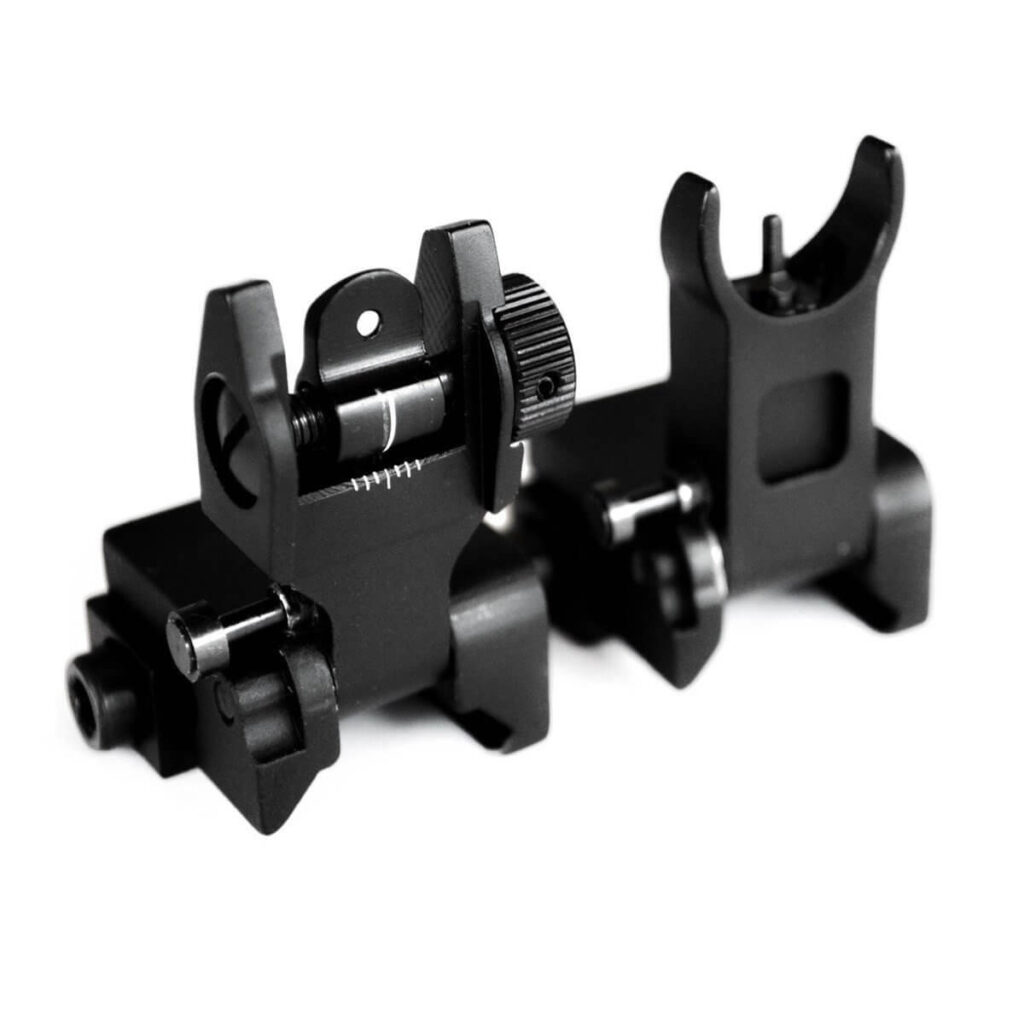
The OZARK ARMAMENT 45 Degree Offset Backup Iron Sights are tailor-made for close-range applications, where rapid transitions between primary and backup optics are essential. These offset iron sights are engineered to provide shooters with a reliable and swift way to switch between their main optical sights and backup iron sights when needed.

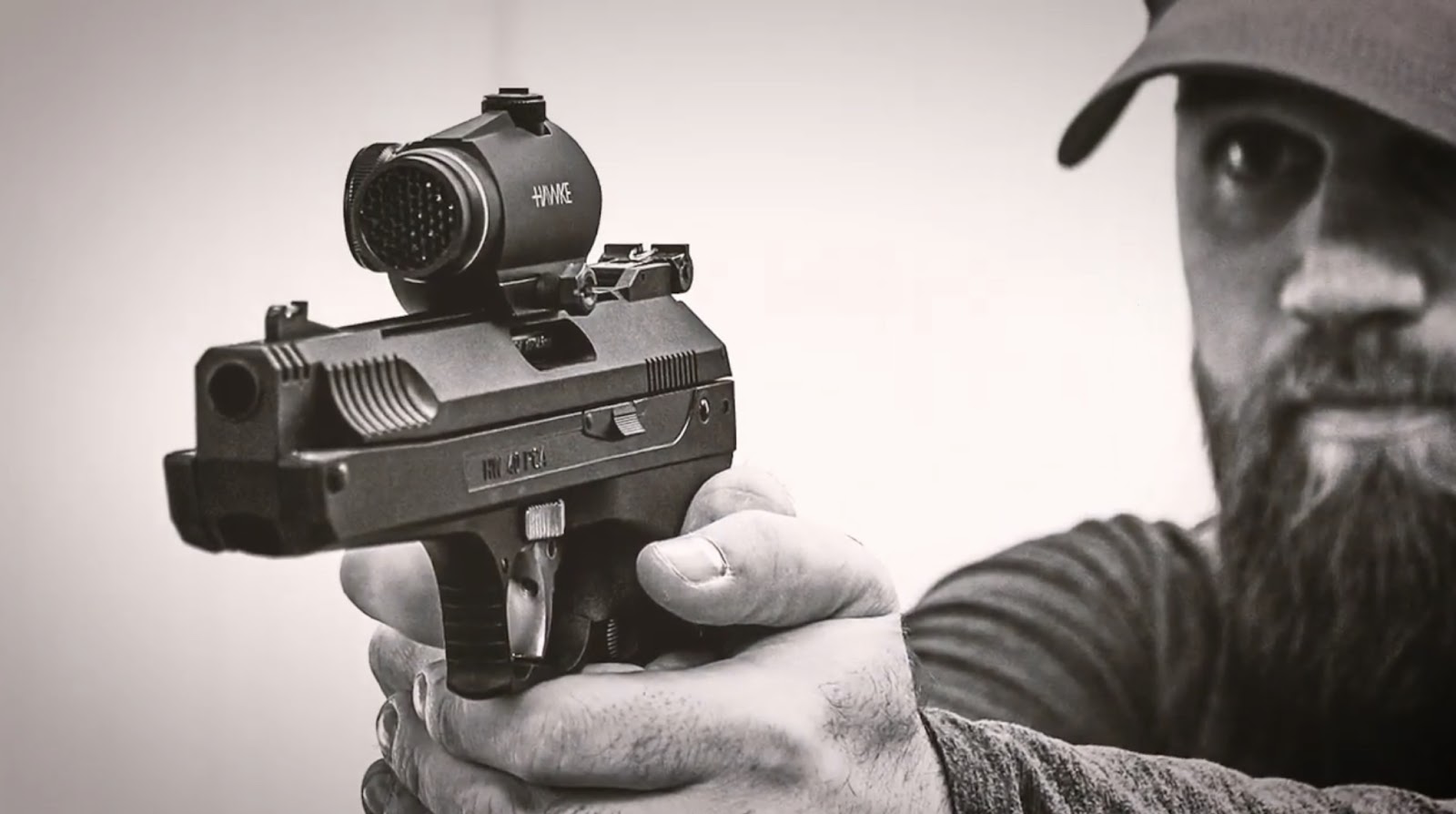
man holding gun
  • One of their standout features is their standard height over bore, which ensures that the sight picture remains consistent with standard iron sights. This means that shooters can maintain muscle memory and familiarity when transitioning to these backup sights, making them an intuitive choice for those who train regularly;
  • Additionally, these sights are designed for Picatinny mount compatibility, offering a hassle-free and secure attachment to firearms equipped with Picatinny rails. This feature enhances their versatility and makes them suitable for a wide range of rifles and setups;
  • The quick and repeatable transition capability of these iron sights is a key asset. In dynamic shooting scenarios or situations where your primary optic may become compromised or obstructed, these 45-degree offset iron sights allow for an almost instantaneous switch to a reliable aiming solution. This agility and readiness can be invaluable in critical moments when split-second decisions are required;
  • The one-year full warranty provided with these sights is another reassuring aspect, ensuring that users can have confidence in their durability and performance over time. Knowing that they are backed by a warranty gives shooters peace of mind when incorporating these sights into their firearms setup.

The OZARK ARMAMENT 45 Degree Offset Backup Iron Sights are purpose-built for close-range use and quick transitions between primary and backup optics. Their standard height over bore and Picatinny mount compatibility make them a practical choice for shooters seeking dependable backup sights. The ability to swiftly switch to these iron sights, coupled with their warranty, enhances their appeal for those who prioritize versatility and reliability in their firearm accessories.

4. Tacticon Armament Flip Up Iron Sights for Rifle

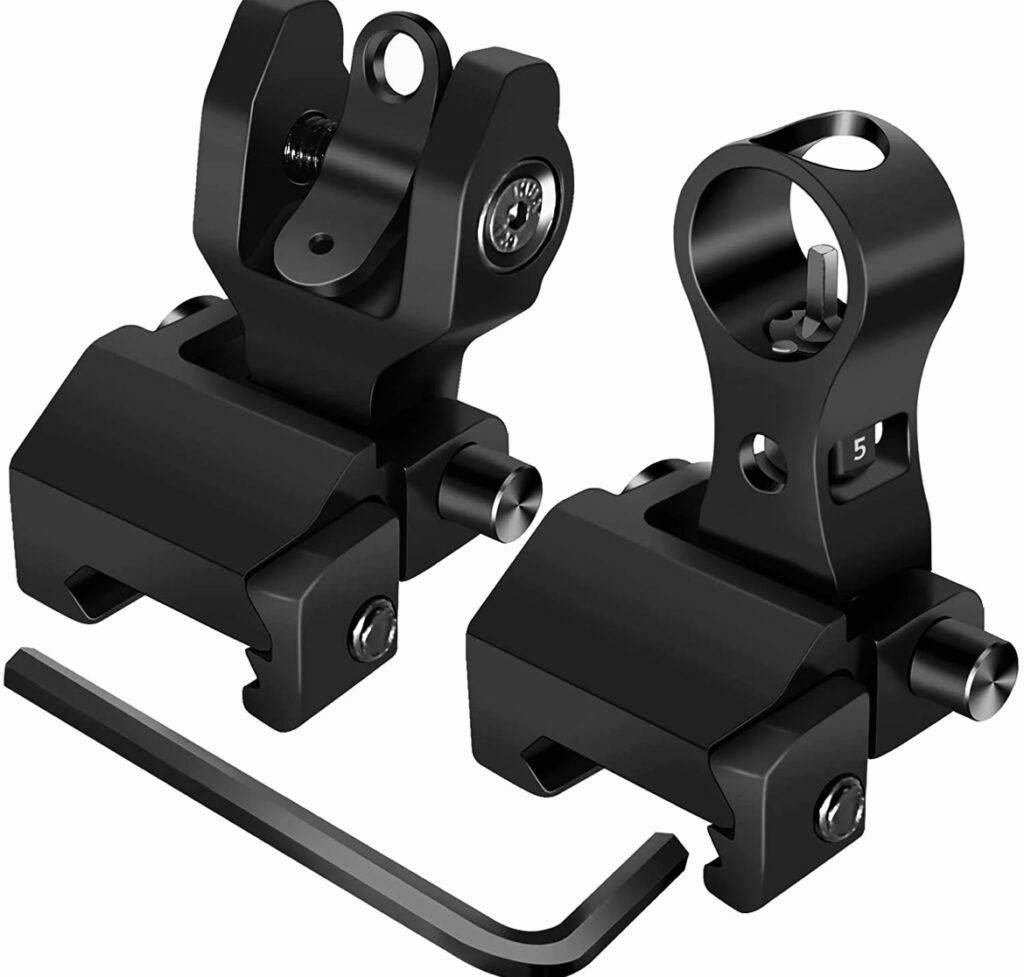
Tacticon Armament has developed a set of Flip Up Iron Sights for Rifles that exemplify quality, functionality, and usability. These iron sights are meticulously crafted from aircraft-grade aluminum alloy, ensuring durability and reliability even in demanding shooting conditions.

  • One of the standout features of these sights is their spring-loaded pop-up action. This design allows for rapid deployment with the simple press of a button, ensuring that shooters can quickly transition to their backup iron sights when needed. This quick response can be critical in situations where time is of the essence;
  • Compatibility is key, and Tacticon Armament has ensured that these sights can be mounted on most Picatinny and Weaver rail sections. This versatility means that they can be seamlessly integrated into various rifle setups without compatibility concerns. This compatibility extends to both tactical and hunting rifles, making them a versatile choice for a wide range of shooters;
  • Included in the package are adjustment tools that enable precise calibration of the sights. Shooters can make windage and elevation adjustments as needed to ensure their shots are consistently accurate. Having these tools included simplifies the setup process, allowing users to fine-tune their iron sights to match their specific requirements;
  • Furthermore, Tacticon Armament includes a front sight adjustment tool, saving users the hassle of purchasing additional tools for sight adjustments. This thoughtful addition demonstrates the brand’s commitment to providing a complete and user-friendly package.

Tacticon Armament’s Flip Up Iron Sights for Rifles are a robust and dependable choice for shooters seeking backup iron sights. Crafted from aircraft-grade aluminum alloy, these sights offer durability and reliability. Their spring-loaded pop-up action, compatibility with various rail sections, and included adjustment tools make them a practical and user-friendly solution for both tactical and hunting rifles.

5. Magpul Industries USA MBUS Front & Rear Flip-Up Backup Sight

Magpul Industries USA brings a cost-effective and reliable backup sight option to the table with their MBUS Front & Rear Flip Up Backup Sight Set. Crafted from lightweight polymer, these sights provide an affordable yet dependable solution for AR-15 owners in need of reliable backup iron sights.

  • The lightweight polymer construction of these sights is a standout feature. While they may not match the ruggedness of steel or aluminum sights, they offer a significant advantage in terms of weight reduction. This is especially appealing to shooters who prioritize a lightweight setup for their AR-15. Additionally, the use of polymer ensures that these sights are resistant to corrosion and abrasions, contributing to their overall durability;
  • One of the key highlights of these sights is the spring-driven flip-up mechanism. This design ensures that the sights are ready for action when needed. Whether it’s transitioning from a primary optic to backup iron sights or quickly engaging targets, the spring-loaded deployment is both rapid and reliable;
  • Another significant benefit of these polymer sights is their ability to hold zero consistently, even under adverse conditions. Shooters can have confidence that their point of impact will remain consistent, ensuring accuracy and reliability in a variety of scenarios. This reliability is especially crucial in high-pressure situations where a quick and accurate shot can make all the difference.

The Magpul MBUS Front & Rear Flip Up Backup Sight Set offers an affordable and practical backup sight solution for AR-15 owners. The lightweight polymer construction, spring-driven flip-up mechanism, and reliable zero retention make these sights a valuable addition to any rifle setup. Whether for casual shooting or as a backup for tactical applications, these sights provide a dependable aiming solution.

6. Magpul MBUS Pro Offset Front and Rear Flip-Up Backup Sights

Magpul’s MBUS Pro Offset Front and Rear Flip-Up Backup Sights are a testament to durability and precision, making them a top choice for AR-15 owners seeking rugged and reliable iron sights. These sights are crafted with an all-steel construction that sets them apart in terms of strength and longevity.

  • One standout feature of the MBUS Pro sights is their Melonite finish. This finish provides exceptional resistance to wear and corrosion, ensuring that these sights can withstand the harshest conditions and heavy use. Whether you’re out in the field or engaged in intense training, the Melonite finish adds a layer of protection to your investment;
  • The 45-degree offset design of these sights is a game-changer for quick deployment. When seconds count, you can rely on these sights to flip up rapidly into position, providing you with a clear and accurate aiming solution. This design is particularly valuable in close-quarters situations where quick transitions between primary and backup optics are essential;
  • Another key advantage of the MBUS Pro sights is their user-friendly windage and elevation adjustments. You can make these adjustments without the need for specialized tools, ensuring that you can fine-tune your point of impact with ease. This feature is invaluable for shooters who demand precision and versatility from their iron sights.

Magpul’s MBUS Pro Offset Front and Rear Flip-Up Backup Sights are a top-tier choice for AR-15 enthusiasts who prioritize durability and precision. The all-steel construction, Melonite finish, and 45-degree offset design make these sights suitable for both tactical applications and challenging shooting environments. With user-friendly adjustments, they offer a seamless aiming experience that meets the demands of discerning shooters.

7. Magpul MBUS PRO Steel Sight

Magpul continues to impress with its lineup of iron sights, and the Magpul MBUS PRO Steel Sight Set MAG275 & MAG276 Black is no exception. These sights are engineered to meet the demands of professional users and enthusiasts who require top-tier performance from their iron sights.

  • One standout feature of these sights is their construction. Crafted from steel, they are built to withstand rigorous use and challenging conditions. The use of steel ensures longevity and durability, making them suitable for heavy-duty applications. Additionally, the sights are treated with a Melonite finish, providing exceptional resistance to corrosion and abrasions. This finish not only enhances their lifespan but also maintains their appearance, even after extensive use;
  • The front sight in this set is designed with a narrow width, making it compatible with various infrared aiming lasers and light installations. This feature caters to professional users who rely on advanced optics and accessories for their firearms. It’s a testament to Magpul’s commitment to providing solutions that cater to a wide range of shooting needs;
  • Both the front and rear sights in this set feature a positive detent mechanism, ensuring reliable and secure deployment. When you need to engage targets quickly, these sights flip up into position with ease, and they hold firmly in place during use. This quick and stable deployment is crucial for professionals in dynamic shooting situations;
  • For users who appreciate precise adjustments, the rear sight is equipped with windage capabilities. This allows for fine-tuning your point of impact without the need for specialized tools. It’s a convenience that adds versatility to these iron sights.

The Magpul MBUS PRO Steel Sight Set MAG275 & MAG276 Black is a testament to Magpul’s dedication to quality and performance. These steel sights, with their Melonite finish and compatibility with advanced optics, cater to the needs of professional users while remaining user-friendly for enthusiasts. The combination of durability, precision, and rapid deployment makes these sights a standout choice for those seeking high-performance iron sights.

Woman holding gun

8. Diamondhead USA Front and Rear Combat Iron Sights

The Diamondhead Integrated Sighting System is a remarkable addition to the world of iron sights, offering unique features that set it apart from the competition. One of the standout characteristics of this sighting system is its diamond-shaped housing, present on both the front and rear sights. This innovative design is not just for aesthetics; it significantly improves target acquisition speed.

  • When aiming down these sights, users will find that the diamond shape allows them to quickly center the front sight post within the rear aperture. This precise alignment aids in acquiring targets faster and more accurately. It’s a feature that appeals to marksmen who demand rapid and efficient target acquisition, especially in dynamic shooting scenarios;
  • Additionally, the Diamondhead Integrated Sighting System includes proprietary reference posts and horizon bars. These elements further enhance accuracy by providing visual cues and reference points for the shooter. When every shot counts, having these additional aids can make a substantial difference in hitting the intended target;
  • The inclusion of 0.5 MOA windage adjustments ensures that users can fine-tune their point of impact with ease. This level of precision is invaluable for marksmen who require consistent and accurate shots. The system’s windage adjustments can be made without the need for specialized tools, simplifying the sight adjustment process;
  • Another advantage of the Diamondhead system is its ability to stow away when not in use. The flip-up sights are designed to rest discreetly when not needed, allowing users to transition seamlessly between primary and backup optics. This feature adds convenience and versatility to the sighting system.

The Diamondhead Integrated Sighting System combines innovative design with practical features to deliver a high-performance iron sight solution. The diamond-shaped housing promotes quick target acquisition, and the proprietary reference posts and horizon bars enhance accuracy. With precise windage adjustments and the ability to stow the sights away, this system caters to the needs of marksmen who require speed and precision in their shooting applications.

9. Ade Advanced Optics Front and Rear Iron Sight

Ade Advanced Optics offers a set of 45-degree offset backup iron sights that excel in providing rapid transitions between primary optics and backup sights. These sights are designed for those situations where quick adjustments and adaptability are paramount without obstructing the main optics.

  • Crafted from lightweight and durable aluminum, Ade Advanced Optics’ sights strike a balance between sturdiness and weight efficiency. The use of aluminum ensures longevity and reliable performance, making these sights a dependable addition to your firearm accessories;
  • One of the key advantages of these 45-degree offset sights is their low-profile design. They sit discreetly at a 45-degree angle to the main optic, ensuring that they don’t interfere with the primary sight picture when not in use. This feature allows users to maintain a clear and unobstructed view through their primary optics until the moment they need to transition to the backup sights;
  • Precise adjustments are crucial when using iron sights, and Ade Advanced Optics delivers in this aspect. The sights come equipped with 0.50 MOA elevation and windage adjustments, allowing shooters to fine-tune their point of impact with ease. These adjustments can be made without the need for specialized tools, enhancing the user-friendly nature of these sights;
  • One of the primary benefits of having offset sights like Ade Advanced Optics’ in your arsenal is their quick deployment. In scenarios where your primary optics may fail or become unusable, these backup sights can be swiftly engaged to maintain target acquisition and situational awareness. This capability adds a layer of reliability and readiness to your shooting setup.

Ade Advanced Optics’ 45-degree offset iron sights offer a practical solution for shooters who require rapid transitions between primary and backup optics. Crafted from lightweight aluminum, they maintain a low profile and provide precise adjustments for accuracy. With their quick deployment capability, these sights enhance the adaptability and reliability of your firearm, ensuring you’re prepared for various shooting scenarios.

10. DAGGER DEFENSE -Combat Vet Owned Company- 45 Degree Flip-Up Sights

DAGGER DEFENSE brings a valuable addition to the world of backup iron sights with their Tactical Backup Iron Sights (BUIS). These sights are constructed from durable aluminum, making them a robust choice for firearm enthusiasts who demand longevity and reliability from their accessories.

  • One of the standout features of DAGGER DEFENSE’s BUIS is their 45-degree canted design. This design allows for versatile aiming options, especially when transitioning between primary and backup optics. When the situation demands, you can swiftly rotate your rifle to engage these sights, ensuring you maintain target acquisition and situational awareness without missing a beat;
  • The spring-loaded deployment mechanism is another noteworthy aspect of these sights. When you need to engage them, simply press a button, and the sights will rapidly spring into action, ready to assist in aiming. This quick and hassle-free deployment ensures you’re always prepared for various shooting scenarios;
  • When it comes to adjustments, DAGGER DEFENSE has you covered. The sights come with the necessary tools for elevation adjustments on the front sight, allowing you to fine-tune your point of impact as needed. This user-friendly approach to sight adjustments ensures that you can maintain accuracy without the need for additional tools or accessories;
  • These sights are designed for compatibility with standard 1913 Picatinny rails, making them suitable for a wide range of rifles and configurations. Their ease of installation and user-friendly features make them a valuable addition to any firearm setup, whether you’re a professional shooter or a recreational enthusiast.

In summary, DAGGER DEFENSE Tactical Backup Iron Sights offer durability, versatility, and user-friendly features. Constructed from aluminum, they provide the ruggedness needed for demanding shooting scenarios. With a 45-degree canted design and spring-loaded deployment, they facilitate quick and precise aiming when transitioning between optics. The included tools for elevation adjustments add to their convenience, making them a reliable choice for various firearm setups.

These AR 15 iron sights cater to a range of preferences, ensuring gun owners can find the perfect backup solution for their rifles.

Mastering the Use of AR 15 Iron Sights

Navigating the realm of AR iron sights may seem like a daunting task, especially in an era dominated by modern optics. Using iron sights with an AR 15 requires a unique skill set and understanding. Contrary to popular misconceptions perpetuated by video games, achieving the “focus on the target while blurring out the front sight” ideal isn’t feasible due to how the human eye functions. Iron sight proficiency demands education, practice, and calibration.

AR iron sights

The Art of Adjusting AR Sights

Adjusting iron sights on an AR 15 is a precise process that guarantees accuracy when it counts. Here’s a step-by-step guide to fine-tune your iron sights:

  • Secure Installation

The first and foremost step in the process of setting up your iron sights is to ensure that they are securely and firmly mounted on your AR-15. This initial step cannot be overstated in its importance, as any wobbling or looseness in the sight can have a detrimental impact on your accuracy and overall shooting consistency. 

When your iron sights are not securely installed, each shot you take can vary in its point of impact, leading to frustration and inconsistency in your shooting performance. A stable and secure installation not only enhances your accuracy but also provides a reliable foundation for precise aiming. 

To achieve this, make sure that your iron sights are correctly aligned with your rifle’s rail system and are tightened securely. Regularly check for any signs of movement or loosening during use, as vibrations from firing can sometimes affect the sight’s stability. By starting with a rock-solid installation, you’ll be better prepared to fine-tune your iron sights for optimal accuracy in subsequent steps of the process.

  • Mechanical Zero

Achieving a mechanical zero for both your rear and front sights is a critical step in the process of setting up your iron sights. This step ensures that your sights are aligned correctly and provides a solid reference point for aiming. Here’s how to accomplish this:

Begin with the rear sight. Your goal is to center the rear sight’s aperture (the small opening you look through) within its housing. This can be achieved by making careful adjustments to the windage (left and right) and elevation (up and down) settings. Many rear sights have click adjustments, allowing you to make precise changes. Count the number of clicks it takes to move the aperture to the center.

Moving on to the front sight, your objective is to level the front sight’s base with the main housing. This step ensures that the front sight post is aligned properly. To achieve this, it’s often recommended to use a specialized tool designed for front sight adjustments. This tool helps you make fine adjustments to the front sight post’s position.

By achieving a mechanical zero for both your rear and front sights, you establish a solid foundation for accurate shooting. These initial adjustments ensure that your sights are aligned correctly, setting the stage for precise aiming and consistent shot placement.

  • Calibration Shots

With your sights mechanically zeroed, it’s time to take your rifle to the range. Position your target at around 25 yards and fire your rifle while maintaining a relaxed body and shooting arm. The key here is consistency in shot placement. This phase allows you to establish a baseline for your rifle’s current accuracy.

  • Measurement and Adjustment

After firing your initial shots, it’s essential to examine your target and take precise measurements of your shot groupings. To modify your point of impact, use the adjustment knobs on your sights. Understanding Minute of Angle (MOA) adjustments is critical in this process, as it helps you make precise changes to your aim.

  • Fine-Tuning

To further refine your rifle’s accuracy, experiment with shooting at different distances. This experimentation will help you determine the specific MOA-to-bullet impact ratio for your firearm. Once you’ve identified this ratio, calibrate your sights accordingly. After adjustments are made, fire additional test shots to confirm that your rifle is zeroed in accurately and consistently. Fine-tuning your iron sights in this manner ensures that you can rely on them for precise aiming in various shooting scenarios.

Factors to Contemplate Before Purchasing Iron Sights

Material Matters

The material of your iron sights plays a critical role in determining their durability and performance in various conditions. When choosing iron sights for your AR 15, it’s essential to consider the materials available and how they align with your intended use.

  • Polymer sights are a budget-friendly option. They are lightweight and can be suitable for recreational shooters or those on a tight budget. However, they tend to be less robust compared to their metal counterparts. Polymer sights may not withstand extreme conditions or heavy use as well as steel or aluminum alternatives. If your AR 15 is primarily used for casual target shooting or occasional plinking, polymer sights can be a cost-effective choice;
  • On the other hand, steel or aircraft-grade aluminum sights are known for their durability and reliability. These materials are robust and can handle rough usage, making them ideal for competitive shooting, tactical operations, or any situation where your AR 15 might be subjected to harsh conditions. Steel sights are less prone to wear and tear, ensuring consistent performance over time.

Your choice of material should align with your specific needs and expectations for your AR 15. If you rely on your rifle for self-defense, professional use, or rigorous training, investing in high-quality steel or aluminum sights is a wise decision. However, for more casual shooters or those working within budget constraints, polymer sights can still provide adequate performance, as long as they’re not subjected to excessive wear and tear. Ultimately, understanding your usage scenarios will help you make an informed decision about the material of your iron sights.

2. Gas Block vs. Same-Plane

Gas block sights are an essential consideration when choosing iron sights for your AR 15, particularly if your rifle is equipped with a low-profile gas block. These sights are designed to accommodate the height difference caused by the gas block, ensuring that the front and rear sights are correctly aligned.

  • Low-profile gas blocks, often used in modern AR 15 designs, sit lower on the barrel than traditional front sight bases. This difference in height can lead to misalignment issues with standard front sights, affecting accuracy. Gas block sights are specifically engineered to address this problem by providing the necessary elevation to match the gas block’s height.
  • On the other hand, same-plane sights are designed to maintain a consistent height relationship between the front and rear sights, even when mounted on a gas block. This means that you won’t need to make additional adjustments to account for the gas block’s height. However, same-plane sights are typically mounted higher than gas block sights, which can affect the overall sight picture and may not be suitable for all shooting scenarios.

Your choice between gas block sights and same-plane sights should be based on your rifle’s configuration and intended use. If you have a low-profile gas block, gas block sights are the logical choice to ensure proper alignment and accuracy. However, if you have a standard front sight base or prefer a higher sight picture, same-plane sights can be a viable option. Ultimately, the choice depends on your specific AR 15 setup and shooting preferences.

AR iron sights

3. Fixed vs. Folding

When it comes to iron sights for your AR 15, you’ll encounter two primary categories: fixed sights and folding sights. Each type has its advantages and considerations, making it crucial to choose based on your intended usage frequency and requirements.

  • Fixed sights, as the name suggests, are permanently attached to your rifle and do not have any moving parts. They offer sturdiness and reliability since there are no components that can break or become misaligned. Fixed sights are a great choice for those who rely on their AR 15 for consistent accuracy and need a setup that requires minimal configuration. They are often favored by tactical operators and competitive shooters who need a reliable aiming solution;
  • Folding sights, on the other hand, are designed with versatility in mind. They can be flipped up into position when needed and folded down when not in use. This feature makes them ideal for those who use their AR 15 for various purposes, including both iron sights and optics. Folding sights are particularly valuable for users who want backup iron sights but plan to primarily rely on a scope or red dot sight. They offer the flexibility to quickly transition between sighting systems.

Your choice between fixed and folding sights ultimately depends on how you intend to use your AR 15. If you need a dedicated, rugged iron sight setup, fixed sights are a solid choice. However, if you require backup sights or want the option to switch between optics and iron sights, folding sights provide the versatility you need. Consider your specific shooting needs and preferences to make the right decision for your AR 15 setup.

4. Ease of Use

The comfort and ease of use of your chosen iron sights for your AR 15 are crucial factors that can significantly impact your shooting experience. These aspects depend on two key factors: the build quality of the sights and your individual skill level as a shooter. When selecting iron sights, it’s essential to consider both of these elements and how they align with your intended usage.

Build Quality:

  • High-quality iron sights with precision machining and durable materials often provide a more comfortable and enjoyable shooting experience. Smooth, well-finished sight components are easier to manipulate, adjust, and maintain;
  • Well-constructed sights also tend to hold their zero and alignment more reliably, which is crucial for consistent accuracy, especially during extended periods of use or under challenging conditions;
  • Consider features like ergonomic design, positive tactile feedback, and user-friendly adjustments when evaluating the build quality of iron sights. These factors contribute to your overall comfort and ease of use.

Skill Level:

  • Your skill level as a shooter plays a significant role in how comfortable and effective iron sights are for you. Novice shooters may benefit from sights with larger, easier-to-see apertures or contrasting color schemes;
  • Experienced marksmen may prefer more precise, adjustable sights that cater to their specific shooting style and preferences;
  • It’s essential to practice regularly with your chosen iron sights to build confidence and proficiency. Familiarity with your equipment will contribute to your comfort and ease of use during extended shooting sessions.

Ultimately, your choice of iron sights should align with your skill level and intended usage. Quality sights that suit your shooting style will enhance your comfort and accuracy, making your AR 15 a more enjoyable and effective tool for your chosen shooting activities.

5. Co-Witness Position

Decide between lower third co-witness (less distraction but less accuracy) and absolute co-witness (always in field of view but potentially distracting) based on your preferences and needs.

6. Sight View

Choose between inline and offset views. Inline provides a co-witness position, ensuring the sights remain in view as long as your optics are undamaged. Offset sights sit at a 45-degree angle off the barrel axis.

In Conclusion

These considerations will guide your choice of iron sights for your AR 15. Tailor your selection to your specific use case, whether it involves frequent use or occasional backup. This thoughtful approach ensures your iron sights will serve as reliable companions for your AR 15 adventures.

  • First and foremost, determine your intended purpose for the AR 15. Are you a competitive shooter, a recreational plinker, or a serious tactical operator? Each of these roles may require different types of iron sights. Competitive shooters often prefer aperture-style sights (also known as peep sights) for their precision, while tactical users might lean toward rugged and adjustable flip-up sights for versatility in rapidly changing situations. Recreational users might prioritize ease of use and cost-effectiveness.
  • Consider the material and construction of the iron sights. Robust materials like steel or aluminum are preferable for longevity and durability, while lightweight alloys may be more suitable for those concerned about weight. Additionally, look for sights with protective coatings that resist corrosion, as this will ensure your investment lasts longer, even in adverse conditions;
  • Adjustability is another crucial factor. Some iron sights offer windage and elevation adjustments, allowing you to fine-tune your shots for accuracy. Others may be fixed, which can be acceptable for certain applications but limit your adaptability;
  • Don’t forget about the sight picture and sight radius. A clear and unobstructed sight picture is essential for accurate shooting, while a longer sight radius can enhance your aiming capabilities. Experiment with different sight styles to find what suits your shooting style best.

Lastly, budget is a practical consideration. Iron sights come in a wide price range, so find a balance between your budget and the features you need. Remember, investing in quality iron sights is an investment in your shooting experience and the reliability of your AR 15. Whether you’re hitting the range for fun or relying on your rifle for defense, thoughtful consideration of these factors will lead you to the perfect iron sights for your needs.

Reflex vs Red Dot Sights: Which Is Better for Your Needs?

In the world of firearm optics, the distinction between a reflex sight and a red dot sight often eludes most individuals. Yet, this knowledge gap is not exclusive to you, dear reader. The purpose here is to delve into the realm of reflex sights and red dot sights, unraveling their intricacies for your enlightenment.

Introduction to Red Dot Sights

Let us commence by demystifying the term “red dot sight.” This nomenclature is, in essence, an umbrella term encompassing a diverse range of sighting devices united by their employment of a red dot for target acquisition. Imagine it as a category wherein prism sights, reflex sights, and holographic sights all find their place. While their operational characteristics and structures may vary, they share a common thread—the red dot.

Therefore, any aiming apparatus employing a red dot for target alignment can be classified under the broad banner of “red dot sight.” This category is inclusive, embracing various designs and functionalities.

Our Top 3 Red Dot Sights

1. Bushnell Red Dot Sight

  • The Bushnell Red Dot Sight stands out for its lightweight and compact design. This feature is particularly advantageous for shooters seeking a nimble and maneuverable optic;
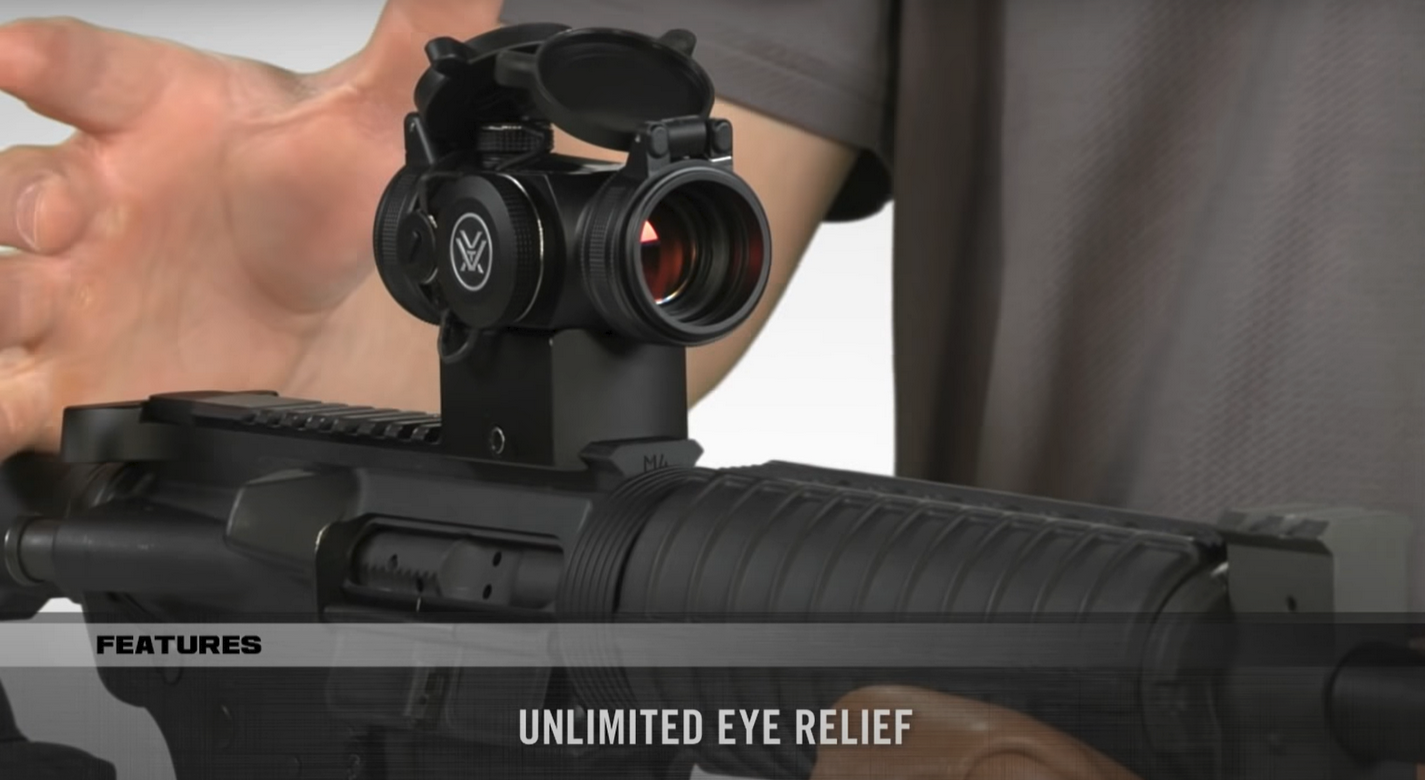
  • It offers unlimited eye relief, ensuring that users can maintain a comfortable shooting position without straining their eyes or compromising accuracy;
  • In low-light conditions, a critical factor in many shooting scenarios, this sight excels. Its performance in such conditions allows shooters to maintain target visibility even during dusk or dawn;
  • This red dot sight includes a mount, simplifying the installation process and saving users the hassle of searching for compatible mounts separately;
  • Its wide field of view is a boon, enabling users to quickly acquire and track targets across a broader area. This characteristic is particularly valuable in fast-paced shooting situations, such as competitive shooting or tactical engagements.

2. Vortex Optics Strikefire II

  • The Vortex Optics Strikefire II offers a 1x magnification, providing a true one-to-one view of the target. This feature is ideal for close-quarters shooting and rapid target acquisition;
  • Its remarkable battery life ensures extended usage without frequent battery replacements. The included battery further simplifies setup, allowing users to get started right away;
  • The sight boasts a solid and durable construction, designed to withstand the rigors of outdoor use and adverse conditions;
  • Unlimited eye relief is another standout feature, enabling shooters to maintain flexibility in their eye positioning without sacrificing accuracy;
  • Its large, multi-coated lens enhances clarity and light transmission, resulting in a bright and sharp sight picture. The wide field of view aids in tracking moving targets, making it a popular choice for dynamic shooting scenarios.

3. Trijicon RMR 6.5 MOA

  • Featuring a 6.5 MOA LED with 1 MOA per click adjustments, the Trijicon RMR offers precise control over dot size and placement, catering to shooters’ preferences and requirements;
  • The sight’s brightness settings are adjustable with multiple options, ensuring optimal visibility in various lighting conditions, from bright daylight to low-light settings;
  • It is equipped with a multi-coated lens that enhances image quality, clarity, and contrast while minimizing glare and reflections;
  • Like its counterparts, the Trijicon RMR is battery-powered, and an included battery simplifies setup, allowing shooters to hit the range or field without delay;
  • Operating this sight is user-friendly, making it accessible to both novice and experienced shooters alike, an important feature in high-stress shooting scenarios.

These red dot sights offer distinct advantages and features, catering to a range of shooting styles and preferences. Whether you prioritize lightweight design, long battery life, or precise adjustments, these options provide valuable choices for enhancing your shooting experience.

Introduction to Reflex Sights

Now, turning our attention to reflex sights, it must be conceded that distinguishing them from red dot sights can be a formidable task without proper knowledge. Reflex and red dot sights are often mistaken for one another, primarily due to their similar appearance.

Yet, other types of sights, such as prism and holographic sights, boast distinctive physical characteristics. Reflex sights stand out in their operation. They employ a low-power LED light projected onto a lens, which then reflects the dot back to the user’s eye—hence, their alternative name, “reflect sights.”

These sights are renowned for their lightweight and compact tube design, housing all components internally. Additionally, they exhibit resilience in extreme conditions and come at an affordable price point. However, they do have limitations, most notably in parallax correction. Nevertheless, their extended battery life and unlimited eye relief make them a valuable asset for shooters, hunters, and law enforcement professionals.

Top 3 Reflex Sights

Budget Friendly: Ohuhu Reflex Sights

  • The Ohuhu Reflex Sight distinguishes itself with its tubeless design, which contributes to a streamlined and lightweight profile, ideal for shooters seeking agility;
  • It offers versatility with 4 reticle patterns and dot sizes, allowing users to tailor the sight to their specific shooting requirements, be it precision or rapid target acquisition;
  • Featuring a built-in mount designed for standard bases, the installation process is simplified, eliminating the need for additional mounting accessories;
  • Its objective lens, while fairly sized, provides a wide field of view, aiding in target tracking and situational awareness;
  • The sight’s shockproof and waterproof construction ensures reliability in demanding environments, making it a reliable choice for outdoor enthusiasts;
  • To kickstart your shooting experience, the Ohuhu Reflex Sight comes with an included battery, sparing you the initial expense.

Editor’s Choice: Feyachi Reflex Sight

  • The Feyachi Reflex Sight offers a generous 42mm reflex lens aperture, allowing for rapid target acquisition by providing a wide sight picture and enhanced peripheral vision;
  • Efficiency shines through its low power consumption, ensuring an extended battery life. Shooters can confidently engage in prolonged sessions without concern for frequent battery changes;
  • Parallax correction and unlimited eye relief are integral to the Feyachi Reflex Sight, ensuring consistent accuracy regardless of the shooter’s eye position;
  • Crafted from high-grade aluminum alloy, this sight is a testament to durability while maintaining a lightweight profile that won’t burden your firearm.

Also Great: Pinty Red Green Reflex Sight

  • The Pinty Red Green Reflex Sight is designed to resist water, enhancing its suitability for wet or humid conditions and reinforcing its longevity;
  • It exemplifies ultimate durability, capable of withstanding the harshest of outdoor challenges, making it a dependable choice for rugged adventures;
  • Offering a remarkable 8 sighting options, shooters can select the reticle that best suits their shooting scenario, enhancing adaptability in the field;
  • Featuring a Picatinny rail mount, it ensures a secure and stable attachment to your firearm, even under recoil or adverse conditions;
  • Tools are included for ease of use, simplifying installation and adjustment, ensuring shooters can quickly get on target.

These reflex sights cater to different preferences and shooting needs, from affordability to quick target acquisition, durability, and adaptability. Selecting the right reflex sight can greatly enhance your shooting experience, whether you’re a casual shooter or a seasoned marksman.

Summary

In summation, a reflex sight and a red dot sight, though akin, are not interchangeable terms. A reflex sight qualifies as a subtype of red dot sight, along with prism and holographic sights. Their operational distinction lies in the utilization of LED light for dot projection, subsequently reflected into the user’s eye.

Pros:

  • Lightweight and compact design;
  • Extended battery life;
  • Durability in various conditions;
  • Affordable price point.

Cons:

  • Limited parallax correction.

As you embark on your journey into the world of firearm optics, remember that the ideal choice hinges on what works best for you. Preferences vary, and what suits a friend may not align with your needs. So, explore, test, and select the sight that complements your shooting style. Your perfect firearm companion awaits discovery. With that, we conclude our enlightening session. We trust you’ve found our discourse beneficial, and we look forward to accompanying you on your future endeavors in the realm of firearm optics. Until then, farewell and safe shooting!

Best Night Scope for Hunting – Top Picks for 2023

Hunting under the cover of darkness has always held a certain allure. The thrill of tracking elusive game in the dead of night, where the world takes on an entirely different hue, is something that appeals to many outdoor enthusiasts. However, to truly make the most of your nocturnal adventures, you need the right gear. That’s where a top-notch night scope for hunting comes into play. In this guide, we’ll dive deep into the world of night vision scopes, helping you find the best one to suit your needs.

Understanding Night Vision

Before we delve into the specifics of choosing the best night scope for hunting, let’s shed some light on how night vision technology actually works. Night vision devices amplify the ambient light available, making it possible to see in near-total darkness. They do this through a process called “image intensification.” Essentially, they collect any available photons (particles of light) and convert them into electrons.

Generation Matters

When shopping for night scopes, you’ll often come across terms like “Gen 1,” “Gen 2,” or even “Gen 3.” These denote the generation of night vision technology used in the scope. Here’s a quick rundown:

Gen 1 (First Generation):

Gen 1 scopes are the entry point into the world of night vision. They are the most affordable and widely available night vision scopes on the market. These scopes are perfect for beginners and those on a budget. If you’re just dipping your toes into night hunting or need a night scope for occasional use, Gen 1 is a reasonable choice.

However, it’s essential to manage your expectations. Gen 1 scopes may not offer the best clarity or long-range performance. In low-light conditions, you might notice some image distortion and reduced visibility at longer distances. Still, for many casual hunters, Gen 1 provides a valuable entry point.

Gen 2 (Second Generation):

As you move up the generational ladder, you reach Gen 2, which is a significant step up from Gen 1. Gen 2 scopes offer better image quality and improved low-light performance. This means you’ll experience clearer and more detailed images, making it easier to spot and identify your targets.

Gen 2 night scopes are favored by many hunters who want a balance between performance and cost. They provide a noticeable improvement over Gen 1 without breaking the bank. For those looking to elevate their night-hunting game, Gen 2 is a solid choice.

Gen 3 (Third Generation):

If you’re serious about night hunting and want the best of the best, Gen 3 is where the real magic happens. These scopes are the cream of the crop when it comes to night vision technology. They offer exceptional image clarity, extended range, and overall superior performance.

Gen 3 night scopes provide a level of detail and brightness that’s unmatched by lower generations. Whether you’re tracking elusive games deep into the night or engaging targets at long distances, Gen 3 scopes excel in all aspects. However, be prepared to open your wallet wide; Gen 3 scopes are quite expensive.

Consider Your Environment

When choosing the best night scope for hunting, it’s essential to consider the environment in which you’ll be using it. Different scopes excel in various scenarios:

  • Woodland and Short Range: For close-quarters hunting in wooded areas, a Gen 1 scope might suffice. Its lower cost makes it a budget-friendly choice;
  • Open Fields and Longer Range: If you plan to hunt in more open spaces or need a longer range, investing in a Gen 2 or Gen 3 scope is wise. The enhanced clarity and range can be a game-changer.

Scope Magnification

Another critical factor to keep in mind is the magnification of your night scope. You’ll often see something like “3×50” or “5×42” written on the scope. The first number represents the magnification power, while the second is the diameter of the objective lens in millimeters.

Choosing the right magnification:

When it comes to magnification, you’ve got some choices to make. It’s not just about zooming in; it’s about finding the sweet spot that matches your hunting style.

Lower Magnification (3-4x):

These scopes offer a wider field of view, making them ideal for tracking moving targets. Let’s face it; animals don’t always stand still and pose for your shot. If you’re out in the wild trying to catch a quick-moving target, a lower-magnification scope is your friend. They excel at short to medium-range hunting scenarios.

Imagine you’re stalking a deer in the woods, and it suddenly dashes to your left. A lower magnification scope lets you keep the creature in your sights without losing track of it in the dense underbrush. It’s all about maintaining that situational awareness.

Higher Magnification (5x and above):

On the flip side, if you need to spot targets at a distance, higher magnification scopes are your best bet. They provide better target recognition, allowing you to identify the fine details that lower magnification scopes might miss.

Picture yourself perched on a ridge, scanning a vast open field for signs of movement. A higher magnification scope lets you pick out distant prey with ease. However, they can be less forgiving if your target is on the move. The increased zoom means any jitter in your hand movements gets amplified, making it trickier to track a fast-moving game.

In the end, your choice of magnification depends on your hunting environment and style. It’s all about finding that balance between getting closer to your target and keeping an eye on the bigger picture.

Infrared Illuminators

In extremely low-light conditions, even the best night vision scope can struggle. This is where infrared (IR) illuminators come into play. These devices emit infrared light, which is invisible to the naked eye but visible to your night vision scope. It effectively “lights up” your surroundings, extending your vision.

Battery Life

Imagine you’re deep in the woods, tracking your prey, and your night scope’s battery dies. Not an ideal situation, right? That’s why it’s crucial to consider battery life when selecting a scope. Look for one with long battery life, and if possible, choose models with easily replaceable batteries.

Durability and Weather Resistance

Hunting often takes you through challenging terrains and unpredictable weather conditions. Your night scope needs to be up to the task. Look for scopes that are ruggedly built and sealed against moisture and dust. This ensures your investment will last and perform well in adverse conditions.

Mounting and Compatibility

Don’t forget to check if the night scope is compatible with your rifle or weapon of choice. Different scopes may require specific mounting systems, so ensure a seamless fit to avoid any complications during your hunting trips.

Budget Considerations

Now, let’s talk dollars and cents. Night vision scopes can range from a couple of hundred bucks to several thousand dollars. Your budget will inevitably play a role in your decision. It’s essential to strike a balance between quality and cost. While it’s tempting to go for the latest and greatest, a well-chosen Gen 1 or Gen 2 scope can provide fantastic value without breaking the bank.

Top Picks for Night Scopes

To help you kickstart your search, here are some top picks in various categories:

  1. Best Budget Night Scope: The Sightmark Photon XT 4.6x42S Digital Night Vision Rifle Scope offers solid performance without emptying your wallet;
  2. Top Gen 2 Choice: The ATN X-Sight II HD 5-20x Day/Night Vision Rifle Scope delivers remarkable clarity and versatility;
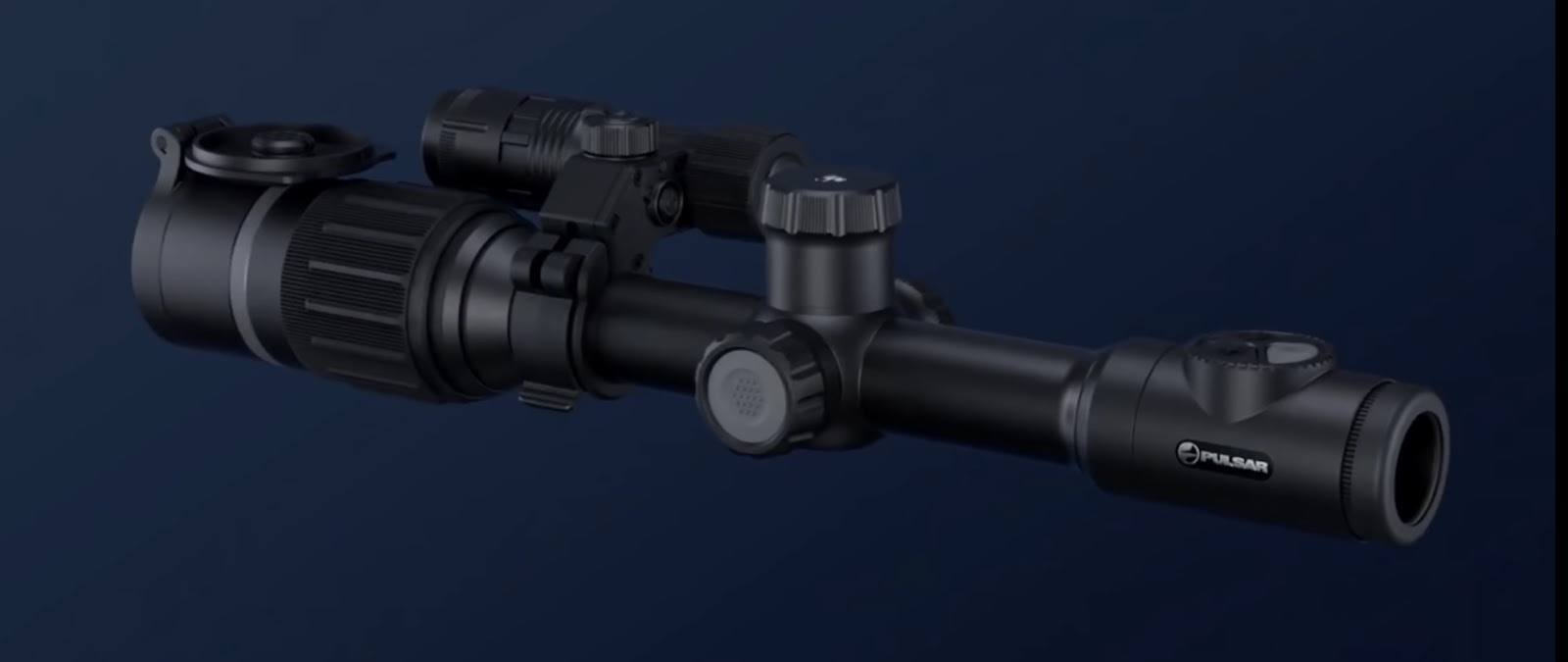
  3. Premium Gen 3 Option: If money is no object, the Pulsar Trail XQ38 LRF Thermal Rifle Scope is a dream come true for serious hunters;
  4. Compact and Lightweight: The Armasight Nemesis6x-SD Gen 2+ Night Vision Rifle Scope is perfect for those who prioritize mobility;
  5. Best for Close-Quarters: The Firefield NVRS 3×42 Gen 1 Night Vision Riflescope offers a wide field of view for short-range hunting.

Conclusion

In the world of night hunting, having the right gear can make all the difference. Whether you’re a beginner on a budget or a seasoned pro looking for the best of the best, there’s a night scope out there to suit your needs. Remember to consider factors like generation, magnification, battery life, and compatibility with your weapon. With the right night scope in your arsenal, your nocturnal hunting adventures will reach new heights of excitement and success. Happy hunting!

Trijicon MRO: Unveiling Optics Excellence for Precision

When it comes to enhancing your shooting accuracy and speed, having the right optics on your firearm can make all the difference. The Trijicon MRO (Miniature Rifle Optic) is one such optic that has garnered attention in the firearms community. In this review, we’ll take a deep dive into the Trijicon MRO, examining its features, performance, and whether it’s worth the investment.

The Trijicon MRO is a compact red dot sight that’s designed to excel in a variety of shooting scenarios. Whether you’re a competitive shooter, a law enforcement officer, or simply a firearm enthusiast, this optic aims to deliver reliable performance. Let’s break down what makes this red dot sight stand out.

Design and Build

  • Sleek and Robust: One of the first things you’ll notice about the Trijicon MRO is its sleek design. It’s a compact and lightweight optic that won’t weigh down your firearm. Plus, it’s built tough. You’ll find that it can handle recoil and rough handling without breaking a sweat;
  • Waterproof and Fog-Resistant: Shooting conditions can be unpredictable. That’s why the MRO is built to be waterproof and fog-resistant. Whether you’re out in the rain or dealing with early morning fog, your sight picture will remain crystal clear;
  • Battery Life: Battery life is often a concern with optics. The MRO addresses this by offering an impressive battery life of up to five years on a single CR2032 battery. This means you can rely on your red dot sight without constantly worrying about changing batteries.

Performance

  • Crisp Red Dot: When you look through the MRO, you’re greeted with a sharp and clear red dot. This dot is easy to acquire and stays consistent, even during rapid target transitions;
  • Adjustable Brightness: Lighting conditions can change in an instant, and the MRO has you covered. It features eight brightness settings, allowing you to fine-tune the red dot’s intensity to match your surroundings;
  • Parallax-Free: One standout feature of the MRO is its parallax-free design. This means that no matter where your eye is positioned relative to the optic, the red dot will stay on target. This is a crucial advantage for quick and accurate shooting;
  • Co-Witness Capable: The MRO is designed to be co-witness capable with iron sights. This means you can use both your red dot and iron sights simultaneously, giving you added flexibility in various shooting scenarios.

Mounting Options

The MRO offers various mounting options to suit your preferences. Whether you prefer a low mount for a more streamlined profile or a higher mount for better visibility, Trijicon provides options to cater to your needs.

Pros and Cons

Pros

  1. Durable Build: The MRO can withstand harsh conditions and heavy recoil, ensuring long-lasting performance;
  2. Battery Life: With up to five years of battery life, you won’t have to worry about frequent replacements;
  3. Parallax-Free: The parallax-free design allows for precise aiming, even if your eye isn’t perfectly centered.

Cons

  1. Price: While the MRO is a top-tier optic, it comes with a premium price tag that may not fit everyone’s budget;
  2. Weight: Some users might find the MRO a bit heavier than other red dot sights in its class.

Is the Trijicon MRO Worth It?

The Trijicon MRO is undeniably a high-quality red dot sight with a reputation for reliability and performance. However, whether it’s worth the investment depends on your specific needs and budget. If you’re a professional shooter or someone who demands the best, the MRO is a solid choice. Its durability, battery life, and parallax-free design make it a valuable addition to your firearm. On the other hand, if you’re on a tight budget or only engage in casual shooting, there are more affordable options available that can still get the job done.

Trijicon MRO: Precision in Every Shot

Understanding the Trijicon Legacy

Before diving further into the Trijicon MRO, it’s essential to acknowledge the company’s heritage. Trijicon has been a trusted name in the world of optics for decades. Their commitment to quality and innovation has earned them a loyal following among military, law enforcement, and civilian shooters. This legacy sets high expectations for any product bearing the Trijicon name, including the MRO.

Optical Clarity

A red dot sight is only as good as its optics, and the MRO doesn’t disappoint. When you peer through this sight, you’ll immediately notice the clarity and sharpness of the red dot. It’s like having a laser beam projected onto your target, allowing for quick and precise aiming.

The MRO also boasts a generous field of view, which is a crucial factor in target acquisition. Whether you’re tracking a fast-moving target or engaging multiple threats, the wide field of view gives you a significant advantage.

Built for All Environments

One of the standout features of the Trijicon MRO is its ability to thrive in various environments. Whether you’re in the scorching heat of the desert or the freezing cold of the Arctic, this sight will perform consistently.

The MRO’s rugged construction can withstand harsh treatment. It’s designed to handle the recoil of high-caliber firearms and resist damage from impacts and drops. You can count on it to endure the rigors of real-world shooting scenarios.

Ease of Use

The last thing you want in a high-pressure situation is an optic that’s challenging to operate. The MRO keeps things simple with its user-friendly controls. Adjusting brightness settings or turning the sight on and off is intuitive and can be done quickly, even in low-light conditions.

The sight’s controls are designed for efficiency, so you can focus on your target without fumbling around with complicated settings. This is a significant advantage when every second counts.

Battery Life that Astounds

Battery life is often a concern when it comes to red dot sights. Fortunately, the MRO addresses this issue brilliantly. With its energy-efficient design, a single CR2032 battery can power the sight for up to five years. This exceptional battery life eliminates the need for frequent replacements and ensures your optic is always ready when you are.

Versatile Mounting Options

Every shooter has their preferences when it comes to mounting height and positioning. The MRO caters to these preferences with a variety of mounting options. Whether you prefer a lower 1/3 co-witness mount or an absolute co-witness mount, Trijicon offers solutions to accommodate your shooting style.

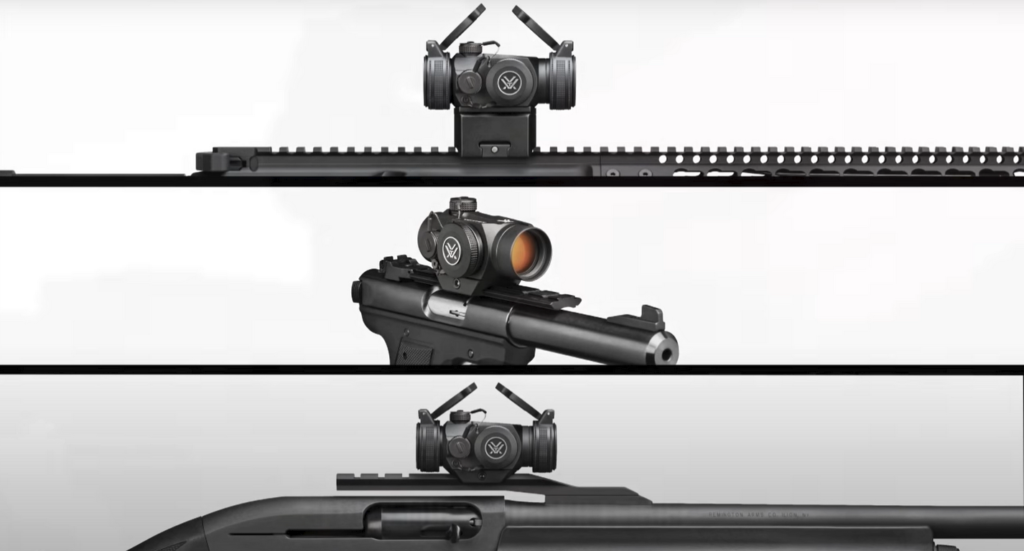
The versatility in mounting options also means the MRO can be easily adapted to various firearms, from AR-15s to shotguns and even pistols with the appropriate adapter plates.

Going Beyond the Range

While the Trijicon MRO is undoubtedly at home on the shooting range, its applications extend far beyond that. Many law enforcement agencies have adopted the MRO as their primary optic, relying on its durability and performance in high-stress situations. Its parallax-free design and quick target acquisition make it an invaluable tool for those in the line of duty.

For hunters, the MRO provides a lightweight and reliable sighting solution. Its ruggedness ensures it can handle the demands of hunting, from tracking game through dense woods to enduring harsh weather conditions.

The Trijicon Warranty

When you invest in a Trijicon product, you’re not just buying an optic; you’re gaining access to Trijicon’s legendary warranty. They stand behind their products with a promise of quality and durability. If your MRO encounters any issues due to manufacturing defects or materials, Trijicon will repair or replace it at no cost to you. This level of support is a testament to their confidence in the products they produce.

Final Thoughts

In conclusion, the Trijicon MRO is a red dot sight that lives up to its reputation. It’s a testament to Trijicon’s commitment to excellence in optics. With its exceptional optical clarity, durability, and user-friendly features, it’s a top choice for shooters who demand the best from their equipment.

While the MRO comes with a premium price tag, it’s an investment in your shooting experience. Whether you’re a professional shooter, a dedicated enthusiast, or someone who values reliability and precision, the Trijicon MRO is a sight that won’t disappoint. Its performance in various environments and its longevity make it a wise choice for anyone looking to enhance their shooting capabilities.

So, if you’re in the market for a red dot sight that delivers precision, durability, and ease of use, the Trijicon MRO deserves a close look. It’s more than just an accessory; it’s a tool that can help you achieve your shooting goals and excel in any situation, from the range to the field. Trust in Trijicon’s legacy and experience the difference the MRO can make in your shooting experience.

Best Light Gathering Rifle Scopes: Enhance Your Precision

When it comes to enhancing your shooting accuracy and performance, having the right rifle scope is crucial. Whether you’re a seasoned hunter or an enthusiastic target shooter, one key factor you should consider in your optics is light-gathering capability. In this guide, we’ll dive deep into the world of rifle scopes to help you find the best light-gathering scope that suits your needs.

https://youtu.be/WJStpgRbY38?feature=shared

Understanding Light Gathering: Why It Matters

Before we jump into the specifics of the best light-gathering rifle scopes, let’s take a moment to understand why light-gathering capability is so vital. Simply put, a scope’s ability to gather light directly affects how well you can see and aim in low-light conditions.

Imagine you’re out hunting during the early morning or late evening hours, or perhaps in dense woods where sunlight is limited. In such scenarios, having a rifle scope that can gather as much available light as possible can make all the difference. It ensures that your target remains visible, even when the light conditions are less than ideal.

Factors Affecting Light Gathering

Several factors contribute to a rifle scope’s ability to gather light effectively. Here are the primary factors to consider:

1. Objective Lens Diameter

The objective lens is the one at the front of your scope, and its size plays a significant role in light gathering. A larger objective lens lets in more light, which can be especially beneficial in low-light conditions. However, it’s important to strike a balance between size and portability, as larger lenses can make your scope heavier and bulkier.

2. Lens Coatings

Lens coatings, such as multi-coated or fully multi-coated optics, can significantly enhance light transmission. These coatings reduce glare and reflections, allowing more light to pass through the lenses and reach your eye. This results in brighter and clearer images, even in challenging lighting situations.

3. Exit Pupil Size

The exit pupil is the diameter of the beam of light that exits the eyepiece and enters your eye. To get the most benefit from light-gathering, the exit pupil of your scope should closely match the size of your own pupil, which varies depending on lighting conditions and age. Ideally, the exit pupil should be larger than your pupil in low light, ensuring you don’t miss any available light.

4. Magnification

Higher magnification scopes tend to have smaller exit pupils, which can limit their light-gathering capabilities. Consider your shooting environment and the distance at which you’ll be engaging targets when choosing the magnification power of your scope. For low-light scenarios, a lower magnification scope with a larger exit pupil might be the better choice.

Top Light Gathering Rifle Scopes

Now that you understand the importance of light gathering, let’s explore some of the top rifle scopes that excel in this aspect:

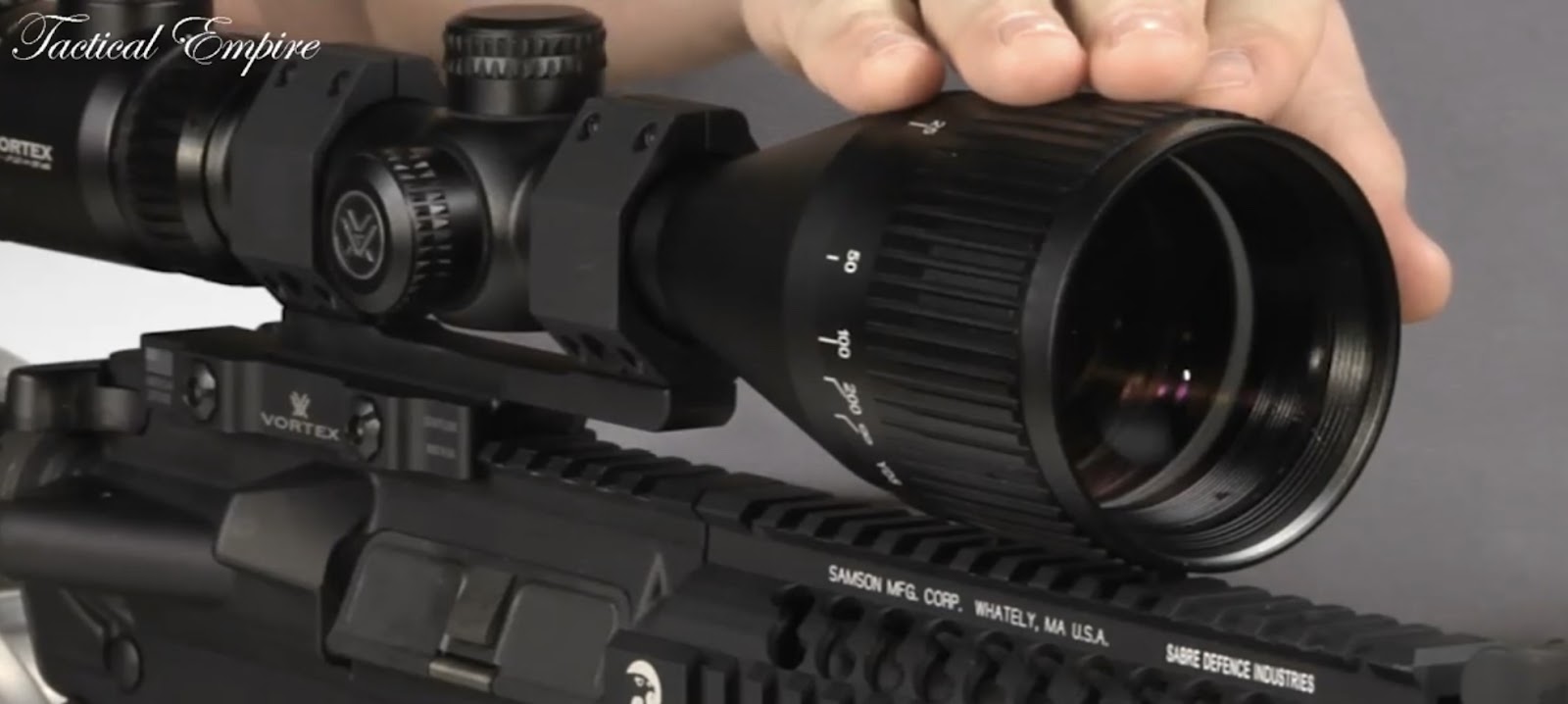
1. Vortex Optics Diamondback 4-12x40mm

The Vortex Diamondback series is renowned for its exceptional optics, and the 4-12x40mm model is no exception. With its 40mm objective lens and fully multi-coated optics, it excels in gathering light even in challenging lighting conditions. It offers a versatile magnification range, making it suitable for various shooting scenarios.

Vortex Diamondback 4-12x40mm: A Closer Look

The 4-12x40mm model from Vortex Diamondback is a standout choice for shooters who demand top-notch light gathering. Its 40mm objective lens strikes a perfect balance between light transmission and portability. In low-light conditions, this scope truly shines, ensuring you won’t miss those critical shots during the dawn or dusk hours.

  • What sets the Vortex Diamondback apart is its fully multi-coated optics. These coatings minimize light reflection and boost light transmission, resulting in bright and clear images. Whether you’re tracking game in the early morning mist or targeting varmints at twilight, this scope’s optics will keep you on target;
  • Furthermore, the 4-12x magnification range provides versatility. It’s suitable for everything from close-range shots to mid-range engagements, making it a valuable companion for hunters and target shooters alike. With its rugged construction and waterproof design, this scope is ready to perform in the harshest conditions;
  • When it comes to reliability, Vortex is a brand that many shooters trust, and the Diamondback series lives up to that reputation. Backed by Vortex’s VIP Warranty, you can have peace of mind knowing that your investment is protected.

The Vortex Diamondback 4-12x40mm rifle scope is a standout choice for those who demand exceptional light-gathering capabilities. Its combination of a 40mm objective lens and fully multi-coated optics ensures that you’ll have a clear and bright view, even when the lighting conditions are less than ideal. Whether you’re a hunter or a target shooter, this scope’s versatility and reliability make it a top contender in the world of optics.

2. Leupold VX-3i 3.5-10x40mm

Leupold is a well-respected name in the optics industry, and the VX-3i 3.5-10x40mm scope lives up to the brand’s reputation. Its Twilight Max Light Management System is designed to optimize light transmission during the critical early and late hours of the day. This scope provides excellent clarity and brightness, even in low-light situations.

Leupold VX-3i 3.5-10x40mm: Shining in Low Light

The Leupold VX-3i 3.5-10x40mm rifle scope is a testament to Leupold’s commitment to delivering exceptional optics, especially in challenging lighting conditions. The scope’s Twilight Max Light Management System is the secret behind its remarkable low-light performance.

  • Designed with hunters and shooters in mind, the Twilight Max system helps maximize light transmission during dawn and dusk when visibility is often limited. It enhances contrast and reduces glare, ensuring that you have a clear and bright image of your target, even when natural light is fading;
  • This scope’s 40mm objective lens is perfectly balanced for light gathering without adding unnecessary bulk to your firearm. It strikes a harmony between portability and performance, making it suitable for various shooting scenarios;
  • The Leupold VX-3i 3.5-10x40mm scope offers versatility through its magnification range. Whether you’re tracking game in the early morning or making precise shots at medium range, this scope can adapt to your needs.

What sets Leupold apart is not only the quality of their optics but also their rugged durability. The VX-3i is designed to withstand the harshest conditions, ensuring it remains a reliable companion on your outdoor adventures.

3. Nikon Monarch 3 4-16x42mm

Nikon’s Monarch 3 scope offers a combination of a generous 42mm objective lens and Nikon’s Ultra ClearCoat optical system. This ensures exceptional light-gathering ability and superb image quality. The 4-16x magnification range provides versatility for both short and long-range shooting.

Nikon Monarch 3 4-16x42mm: A Clear Advantage

The Nikon Monarch 3 4-16x42mm rifle scope is designed to provide shooters with a clear advantage, particularly in low-light situations. Its 42mm objective lens is at the upper end of the size spectrum, allowing it to capture an impressive amount of light. This means that even as the sun dips below the horizon, your view through the Monarch 3 remains crisp and bright.

  • Nikon’s Ultra ClearCoat optical system is the secret behind this scope’s exceptional light-gathering ability. It reduces reflections and glare, allowing more light to pass through the lenses and reach your eye. The result? A crystal-clear image with vibrant colors, even in challenging lighting conditions;
  • What sets this scope apart is its 4-16x magnification range. This wide range of magnification makes the Monarch 3 incredibly versatile. Whether you’re taking close shots in thick woods or making precision shots at long distances, this scope can adapt to your needs.

The Nikon Monarch 3 4-16x42mm scope is built with durability in mind. It’s rugged, waterproof, and fog-proof, ensuring it can withstand the rigors of the field. Plus, Nikon’s reputation for quality and reliability means you can trust this scope to perform consistently.

4. Burris Fullfield II 3-9x40mm

The Burris Fullfield II 3-9x40mm scope is known for its affordability without compromising on performance. With a 40mm objective lens and index-matched, multi-coated lenses, it delivers impressive brightness in low-light conditions. This scope is a great option for budget-conscious shooters who still want top-notch light gathering.

Burris Fullfield II 3-9x40mm: Affordable Excellence

When it comes to finding a rifle scope that strikes the perfect balance between affordability and performance, the Burris Fullfield II 3-9x40mm stands out as an excellent choice. This scope’s 40mm objective lens is designed to gather light effectively, ensuring that you maintain clear visibility even when the sun is setting.

  • What sets the Burris Fullfield II apart is its index-matched, multi-coated lenses. These coatings optimize light transmission, reduce glare, and enhance image clarity. The result is impressive brightness and sharpness in low-light conditions, making it a valuable asset for hunters who often find themselves in challenging lighting scenarios;
  • The 3-9x magnification range offers versatility, allowing you to adapt to various shooting distances. Whether you’re stalking game in dense woods or taking precise shots at mid-range distances, this scope can handle the task.

While the Burris Fullfield II is budget-friendly, it doesn’t compromise on durability. It’s built to withstand the demands of the field, with a rugged construction that’s both shockproof and waterproof. This means you can rely on it in various weather conditions without worrying about performance.

Conclusion

In the world of rifle scopes, the ability to gather light effectively is a game-changer. Whether you’re out hunting at dawn or dusk or shooting in dimly lit environments, having a scope that excels in light gathering can give you a significant advantage. Consider factors like objective lens diameter, lens coatings, exit pupil size, and magnification when choosing the best light gathering rifle scope for your needs.

To ensure you’re getting the most out of your investment, opt for reputable brands like Vortex, Leupold, Nikon, and Burris, known for their commitment to quality and performance. With the right light gathering rifle scope, you’ll be well-equipped to hit your targets in any lighting condition, putting your shooting skills in the best possible light.

Hunting’s Environmental Benefits: A Closer Look

Hunting, often viewed through a narrow lens as a sport or recreational activity, plays a crucial role in conserving and maintaining our environment. While some might argue that hunting is harmful to wildlife and the ecosystem, a deeper look reveals that it can actually be a force for good. In this article, we’ll explore how hunting helps the environment in various ways, from controlling wildlife populations to funding conservation efforts.

1. Population Control: Balancing the Scales

One of the most significant contributions of hunting to the environment is its role in population control. When certain animal populations grow unchecked, it can lead to overgrazing, habitat degradation, and increased competition for resources. This imbalance can have far-reaching consequences for the entire ecosystem.

Hunters, with the proper permits and regulations in place, help maintain the delicate balance of nature by harvesting surplus animals. By doing so, they prevent overcrowding and ensure that the available resources are sufficient for the remaining individuals. This, in turn, benefits not only the targeted species but also the plants and other animals that share the same habitat.

2. Conservation Funding: Dollars for Preservation

One might wonder how hunting can be linked to conservation, but the answer lies in the substantial financial contributions made by hunters. Through hunting licenses, permits, and taxes on firearms and ammunition, hunters generate significant revenue that directly supports conservation efforts.

Organizations like the U.S. Fish and Wildlife Service rely on these funds to protect and restore habitats, conduct research, and enforce wildlife laws. Without the financial support of hunters, many of these vital conservation initiatives would be underfunded and unable to achieve their goals.

3. Habitat Preservation: A Safe Haven

Hunting, when done responsibly, encourages landowners to preserve natural habitats. Private landowners often see the value in maintaining healthy ecosystems, both for recreational hunting opportunities and as a way to increase property values. This results in the conservation of vast areas of wilderness that might otherwise succumb to development.

Additionally, hunting organizations and clubs often purchase or lease land for hunting purposes. These properties serve as sanctuaries for wildlife, providing safe havens where animals can thrive without the threat of habitat destruction. This land stewardship, driven by hunting interests, contributes significantly to overall environmental preservation.

4. Wildlife Management: A Science-Driven Approach

Hunting is not just about taking aim and shooting; it’s a science-driven activity. Wildlife management professionals carefully study populations, migration patterns, and habitat conditions to establish sustainable hunting seasons and bag limits. These regulations ensure that hunting activities are conducted in a way that maintains healthy wildlife populations.

Through these data-driven approaches, hunters actively participate in the long-term well-being of the species they pursue. By adhering to these scientifically informed guidelines, they help protect the ecological balance.

5. Reducing Human-Wildlife Conflicts

Human-wildlife conflicts are a growing concern as urban areas continue to encroach on natural habitats. In many cases, hunting can be an effective tool for mitigating these conflicts. When certain species become overpopulated in urban or suburban environments, they can pose risks to human safety and property.

Hunters, in collaboration with wildlife agencies, can help address these issues by reducing the local wildlife population to manageable levels. This not only minimizes the potential for conflicts but also ensures that these animals continue to play their roles in the ecosystem without unnecessary harm to human communities.

6. Ethical and Sustainable Hunting Practices: Setting Standards

It’s essential to emphasize that hunting has evolved significantly over the years, with a growing focus on ethical and sustainable practices. Modern hunters are increasingly aware of their impact on the environment and are committed to preserving nature while enjoying their sport.

Ethical hunting involves respecting laws and regulations, hunting only within established seasons, and adhering to bag limits. Many hunters also invest in conservation efforts by voluntarily contributing to organizations that protect wildlife and their habitats. By setting these standards and actively participating in conservation, hunters demonstrate their dedication to environmental stewardship.

7. Biodiversity and Ecosystem Health: A Ripple Effect

Hunting often targets specific species, but its effects ripple throughout ecosystems. When the population of one species is managed effectively, it has a positive domino effect on the entire ecosystem. For example, controlling the population of a predator species can prevent the decline of prey species and, in turn, promote biodiversity.

Maintaining biodiversity is essential for ecosystem health and resilience. It ensures that a wide range of species, each with unique roles, continues to contribute to ecosystem functions such as pollination, seed dispersal, and nutrient cycling. By helping to preserve biodiversity, hunting indirectly supports the overall health of our ecosystems.

8. Invasive Species Management: Protecting Native Habitats

Invasive species pose a significant threat to native ecosystems by outcompeting native species for resources and disrupting natural food chains. These invaders often lack natural predators, allowing their populations to explode. Hunting can be an effective strategy for managing invasive species.

Many hunters take on the challenge of hunting invasive species, contributing to their control and reduction. This targeted approach helps protect native habitats, allowing indigenous flora and fauna to flourish. In this way, hunting serves as a valuable tool in the ongoing battle against invasive species and their destructive impact on the environment.

9. Education and Conservation Awareness: Fostering Connection

Hunting fosters a deep connection between individuals and the natural world. Hunters often spend countless hours in the great outdoors, observing wildlife and studying their habits. This firsthand experience creates a sense of responsibility and a strong desire to protect and conserve the environment.

Hunting also provides opportunities for education and outreach. Many hunting organizations and clubs organize workshops, seminars, and youth programs to teach ethical hunting practices and conservation principles. These initiatives not only help pass on valuable knowledge but also instill a sense of stewardship in the next generation of conservationists.

10. Collaboration with Non-Hunters: Finding Common Ground

While hunting may not be everyone’s preferred way to engage with nature, it’s crucial to recognize that hunters and non-hunters share a common goal: the preservation of our environment. Collaboration between these groups can lead to more effective conservation efforts.

Non-hunting individuals and organizations can work alongside hunters to support initiatives such as habitat restoration, wildlife research, and policy advocacy. By bridging the gap between different perspectives, we can harness collective efforts to address environmental challenges comprehensively.

Conclusion: A Holistic Approach to Conservation

In a world facing numerous environmental challenges, it’s essential to take a holistic approach to conservation. Hunting, when practiced responsibly and in conjunction with scientific principles and regulations, plays a vital role in this broader effort. It contributes to population control, provides funding for conservation, fosters habitat preservation, and supports biodiversity.

Moreover, ethical hunting practices, invasive species management, education, and collaboration demonstrate how hunting can positively influence the environment in various ways. By recognizing and valuing these contributions, we can cultivate a greater understanding of the intricate relationship between humans and the natural world.

In the grand tapestry of conservation, hunters are just one thread, but together with other individuals and groups dedicated to environmental protection, they form a united front working towards a more sustainable and harmonious coexistence with our planet’s diverse ecosystems.

Trijicon RM01 Review: Unveiling the RMR RM01 Red Dot Sight

When it comes to aiming for precision and accuracy, having the right optic can make all the difference. Enter the Trijicon RMR RM01, a red dot sight that’s been making waves in the firearms community. In this comprehensive review, we’ll dive deep into what makes the Trijicon RMR RM01 a top-notch choice for shooters of all levels. From its rugged build to its crystal-clear optics, we’ll cover it all.

Unboxing the Trijicon RMR RM01

The first impression often sets the tone, and the Trijicon RMR RM01 doesn’t disappoint. Straight out of the box, you’re met with a sturdy, compact sight that feels like it can handle whatever you throw at it. It’s like opening a treasure chest filled with shooting potential.

Build Quality: Built Like a Tank

When it comes to optics, durability is paramount. The Trijicon RMR RM01 boasts a robust construction that’s built to withstand the harshest conditions. Its forged aluminum housing feels solid in your hands and offers protection against rough handling, recoil, and the elements. It’s a sight that’s as tough as nails.

Optics: Crystal Clear Clarity

The heart of any sight is its optics, and the Trijicon RMR RM01 doesn’t disappoint in this department. The glass is clear as day, providing a crisp and unobstructed view of your target. Whether you’re shooting in bright daylight or low-light conditions, the adjustable brightness settings ensure that the reticle remains visible, no matter the environment.

Red Dot: Precision Personified

The red dot is where the Trijicon RMR RM01 truly shines. It offers a 3.25 MOA dot size, which strikes the perfect balance between precision and speed. Whether you’re engaging targets up close or taking long shots, this red dot sight delivers the accuracy you need. It’s like having a laser beam at your disposal.

Battery Life: Longevity at its Best

Nobody wants to be swapping out batteries constantly, especially in the middle of a shooting session. The Trijicon RMR RM01 boasts exceptional battery life, which can last for years on a single CR2032 battery. This means you can focus on your shots instead of worrying about your sight’s power source.

Mounting Options: Versatile and Easy

Installing the Trijicon RMR RM01 on your firearm is a breeze. It offers versatile mounting options, making it compatible with a wide range of firearms. Whether you prefer a low-profile mount or a co-witness setup, this sight can adapt to your needs. Plus, its user-friendly design ensures a hassle-free installation process.

Adjustment Controls: Simple and Intuitive

Adjusting the settings on the Trijicon RMR RM01 is a walk in the park. The tactile buttons make it easy to change the brightness levels and switch between modes. There’s no need for complicated menus or fumbling around – everything you need is at your fingertips.

  • Whether you’re in the heat of a competitive shooting match or silently stalking prey in the field, quick and intuitive adjustments can be the difference between success and frustration. Trijicon understands this, and they’ve designed the RMR RM01 with user-friendliness in mind;
  • The brightness adjustment buttons are conveniently placed on the sides of the sight, allowing you to make changes without taking your eyes off the target. The clicks are distinct, providing tactile feedback that confirms each adjustment, even in low-light conditions. It’s a simple and effective system that ensures you get the reticle brightness you need, when you need it;
  • Switching between modes is just as straightforward. The Trijicon RMR RM01 offers versatile options to suit your shooting preferences, including automatic and manual modes. With a quick press of a button, you can seamlessly transition between these modes, adapting to changing shooting conditions without missing a beat.

In the field, every second counts, and the Trijicon RMR RM01’s user-friendly design ensures that you spend more time focusing on your target and less time wrestling with complicated settings. It’s a testament to Trijicon’s commitment to providing shooters with tools that make their lives easier and their shots more accurate.

Waterproof and Fog-Proof: Ready for Any Weather

Mother Nature can be unpredictable, but the Trijicon RMR RM01 isn’t. It’s not just waterproof; it’s also fog-proof. So, whether you find yourself in a downpour or dealing with a sudden temperature change, your sight will remain crystal clear and reliable.

  • Let’s talk about waterproofing first. The Trijicon RMR RM01 boasts an impressive level of water resistance, ensuring it can handle even the heaviest rainstorms without skipping a beat. You won’t have to worry about moisture seeping into your sight and affecting your accuracy. It’s a reassuring feature for those who shoot in various weather conditions, where a sudden downpour can be more than an inconvenience;
  • But what about fog? Foggy conditions can be particularly challenging, especially if you’re hunting in the early morning or late evening when temperatures fluctuate. The Trijicon RMR RM01 takes care of this concern with its fog-proof design. The sight’s internal components are sealed tight, preventing any internal fogging that could obscure your view.

This level of environmental resilience ensures that the Trijicon RMR RM01 remains dependable when you need it most. Whether you’re a law enforcement officer working in all-weather conditions or an avid outdoorsman exploring the wilderness, knowing your sight won’t be compromised by Mother Nature’s whims gives you peace of mind and helps you maintain your shooting accuracy. It’s a testament to Trijicon’s commitment to quality and reliability.

Accuracy on the Range: Hitting the Bullseye

The true test of any optic is its performance on the range, and the Trijicon RMR RM01 doesn’t disappoint. It consistently delivers precise shots, allowing you to hit your mark with ease. Whether you’re a competitive shooter or a seasoned hunter, this sight will help you up your game.

  • On the range, the Trijicon RMR RM01 shines brightly, figuratively and literally. Its exceptional clarity and parallax-free design mean that your target and reticle stay in perfect alignment, no matter your shooting angle. This eliminates the frustrating guesswork associated with some lesser optics;
  • Whether you’re engaging targets at close-quarters or reaching out to distant steel, the 3.25 MOA dot size on this sight ensures quick target acquisition while maintaining pinpoint accuracy. It’s like having a precision instrument mounted on your firearm, and it gives you a significant edge when speed and accuracy matter most;
  • For competitive shooters, the Trijicon RMR RM01 provides the advantage needed to climb up the leaderboard. Its quick target acquisition and minimal sight picture obstruction enable rapid follow-up shots and transitions between targets. This sight lets you stay on target and in control, even during the most demanding competitions;
  • For hunters, the Trijicon RMR RM01 brings a new level of confidence to your shots. Whether you’re stalking elusive game in low-light conditions or taking that critical long-range shot, this sight’s dependable performance ensures you won’t miss your opportunity. It’s the difference between a successful hunt and a missed opportunity.

In the world of optics, performance is the name of the game, and the Trijicon RMR RM01 is a true performer. Its consistency, accuracy, and versatility make it a valuable addition to any firearm. So, if you’re serious about improving your shooting skills and hitting your mark every time, the Trijicon RMR RM01 is the sight that will help you achieve your goals.

Price Point: Quality Comes at a Cost

While the Trijicon RMR RM01 offers top-tier performance, it’s important to note that quality does come at a price. This sight is an investment, and it may not be the best choice for budget-conscious buyers. However, if you’re looking for a sight that will last and deliver exceptional performance, the Trijicon RMR RM01 is worth every penny.

Final Thoughts: A Sight to Behold

In conclusion, the Trijicon RMR RM01 is a sight to behold. With its rugged build, crystal-clear optics, and precision red dot, it’s a top-notch choice for shooters who demand the best. While it may come with a higher price tag, the performance and durability it offers make it a worthy investment. Whether you’re a competitive shooter or a dedicated hunter, the Trijicon RMR RM01 will help you take your shooting game to the next level. So, if you’re in the market for a red dot sight that’s built to last and performs like a champ, look no further than the Trijicon RMR RM01. It’s truly a sight worth its weight in gold.

Mastering the Art of Aligning and Calibrating Iron Sights

In a world increasingly enamored with sophisticated scopes and digital optics, the timeless iron sights often go unnoticed. Yet, their reliability and durability make them invaluable, especially as a backup sighting system. 

Ensuring they are precisely aligned and calibrated is essential, not only for shooting accuracy but also for effective self-defense and safe firearm use. This comprehensive guide sheds light on the nuances of aligning and fine-tuning iron sights to achieve optimal performance.

Aligning and Calibrating Iron Sights

Some marksmen favor calibrating at 25 meters, while others opt for a 50-yard alignment. Certain scenarios might even require an alignment at 100 yards, but it’s crucial to consider how this impacts shorter-range accuracy. For this guide, the focus will be on a 50-yard alignment, often considered a happy medium.

Factors to account for:

  • Bench-Rest Quality: If grouping is inconsistent, assess the stability of your bench rest. It should provide ample support and eliminate extraneous variables that could affect your shooting;
  • Skill Level: For novices struggling to maintain a tight group, a qualified gunsmith’s expertise might be beneficial for initial alignment. Following that, consistent practice is key to improvement;
  • Elevation and Windage: If attaining the perfect alignment is challenging, break down the process. Start by focusing solely on either elevation or windage adjustments. Complete a three-round group, make the necessary changes, and then proceed to the other;
  • Initial Proximity: Should the sights be grossly misaligned, to the extent that shots are missing the paper target, begin at a closer distance like 10 yards. Attain basic alignment at this range before incrementally moving out to 25 and then 50 yards.

Point of Aim vs. Point of Impact

The two key terms in the realm of firearm alignment are Point of Aim (POA) and Point of Impact (POI). The POA refers to the target as seen through the aligned sights, whereas the POI signifies where the bullet makes contact with the target. The objective is to align the POA and POI as closely as possible.

Decoding the Anatomy of Iron Sights

Different firearms feature varying types of iron sighting systems. The alignment process can differ considerably depending on the model and make of the firearm. For instance, AK series rifles predominantly use the rear sight for elevation adjustments, while the AR series employs the front sight. 

It’s crucial to comprehend which sight—front or rear—controls elevation and windage before making any adjustments.

Calibrating Elevation

Should your firearm rely on the front sight for elevation tweaks, you’ll need to adjust it in the direction opposite to where you want the Point of Impact to move. For example, if shots are hitting below the intended target, the front sight should be lowered.

Properly aligned iron sights are an underestimated asset in any shooting arsenal. While often overshadowed by more modern optics, their simplicity, reliability, and effectiveness in different conditions make them invaluable.

Understanding how to precisely calibrate them can significantly improve shooting proficiency, irrespective of whether they are the primary sighting system or a backup. This guide aims to equip you with the knowledge and tools to perfect this essential skill.

Fine-Tuning Vertical Alignment

To lower the Point of Impact (POI), elevate the front sight. Conversely, if the rounds hit above the intended mark, lifting the front sight will effectively lower the POI. If it’s the rear sight that controls vertical alignment, remember that moving the rear sight in the same direction as the desired POI will yield accurate results. 

For instance, if a round lands higher than targeted, lowering the rear sight should rectify this discrepancy.

Calibrating Horizontal Alignment

When the front sight is responsible for horizontal (windage) alignment, the principle remains the same. For example, if the shot strays to the left, shifting the front sight to the left will move the POI toward the right. 

However, if it’s the rear sight that controls windage, simply move it in the direction you wish the POI to go. If a round misses to the left, moving the rear sight to the right should align the POI with your intended target.

Preliminary Research Before Testing

Before hitting the shooting range, it’s crucial to understand the specifics of sight alignment for your particular firearm. A plethora of resources can assist in this, from user manuals to military guidelines and online video tutorials. Knowing the details of your firearm’s sight system is paramount to making effective adjustments.

Ensuring Proper Sight Alignment

Correct sight alignment is the cornerstone of accurate shooting. With open sights, the aim is to position the front sight equidistantly between the two posts of the rear sight assembly. The tops of the front and rear sights should form a straight line. 

For peep sights, it’s crucial to center the front sight in the middle of the rear peep sight as precisely as possible. Firearms like the AR, Scorpion, and HK long guns offer multiple peep sight dimensions to aid in precise aiming.

Fundamentals of Calibrating Metal Sights

Once a basic understanding of metal sight usage and shooting technique is attained, it’s time to calibrate or ‘zero’ the firearm. Various elements, such as firearm type, caliber, and the intended use, will influence the appropriate distance for calibration. For instance:

  • Rifles: Understanding the ballistics of a particular round can be beneficial. Various platforms offer Battle Sight Zeroes (BZOs) such as a 50/200 yard zero for an AR-15, enabling accurate shots between 25 and 200 yards;
  • Handguns: Typically, a distance between 15 to 25 yards is optimal for self-defense purposes.

Selecting an Appropriate Target

Although there are targets specifically designed for calibrating certain types of firearms like AR-style rifles, they are not obligatory. A large, conventional bullseye or grid-type target usually suffices. 

Some prefer multi-bullseye targets, offering a central bullseye surrounded by others in each corner. This design allows for easy adjustments without the need to change the target, especially useful if initial attempts are far from the intended mark.

Stabilizing Your Firing Stance

Accurate shooting demands a stable platform for launching projectiles. When using a rifle, the prone position offers an advantageous base. You can enhance stability by employing a bipod or using makeshift supports like sandbags or backpacks. Alternatively, seated shooting at a bench can also yield satisfactory results. The primary goal is to mitigate movement that could throw off your aim.

For handguns, the dynamics are somewhat different. A prone position doesn’t generally offer substantial benefits. However, seated shooting, especially when utilizing a specially designed bench, can facilitate a more stable shooting position for handguns. You can rest your shooting arm on the bench for more consistent aim and recoil management.

Commencing the Live-Fire Exercise

After setting up the range and targets, and assuming a stable firing position, it’s time for the exhilarating part: live-fire. Load your magazines, don your hearing and eye protection, and ensure you are comfortably positioned.

The golden principle is to fire slowly, concentrating on three rounds initially. The focus should be on achieving impeccable alignment of your aiming system, whether it be open or optical, mastering the trigger control, and maintaining a firm but relaxed grip.

After sending these three rounds downrange (ensure it’s safe to do so, particularly if it’s a public range), assess your shot grouping. You can then decide on two different paths:

  • Precise Corrections: For those adept at calculations, measure the distance your grouping is from the target center. If familiar with Minute of Angle (MOA) adjustments, this data can help make precise modifications to your firearm’s aiming device settings. While this is simpler with certain firearms like those with A2/A4 configuration, it may be more challenging with others;
  • Trial and Error: For a more straightforward approach, simply observe the position of your shot group relative to your Point of Aim (POA). Record these observations mentally or capture a photo with your phone for reference. Then, make subtle alterations to your firearm’s aiming system settings to align your Point of Impact (POI) with your POA. Fire another set of three rounds, observe, and make further tweaks as necessary.

Revisiting the Calibration Process

To ensure the most accurate shooting, it’s essential to conduct the calibration process on a stable platform. This could be a dedicated bench rest or even something as simple as a set of sandbags. Unwanted movement, even if minimal, can significantly affect your shot placement.

Begin by placing a target at a distance of 25 yards and fire a three-round grouping. Examine where your projectiles land on the target to determine the necessary modifications for both lateral and vertical alignment.

  • Elevation Adjustments: If your aiming device at the front of the firearm is adjustable, tweak its position in the opposite direction to where you want your shots to go. If the front post isn’t adjustable, then turn your focus to the rear aiming system for elevation modifications;
  • Windage Corrections: For lateral adjustments, typically you’ll use the rear aiming device’s lateral adjustment knob. However, elevation could also be a factor, and for that, you’ll rely on the vertical adjustment dial at the rear. A helpful acronym to remember is FORS (Front Opposite, Rear Same).

Conduct subsequent three-round tests and make adjustments until you reach satisfactory alignment between your POA and POI. Once that’s achieved at 25 yards, move the target to 50 yards to refine your alignment, focusing primarily on vertical adjustments.

Concluding Remarks

Calibrating a firearm’s aiming system is an exercise in patience, precision, and practice. Understanding the mechanisms that affect your shots—be it open or optical aiming systems—and how to manipulate them is the first step. Implementing that knowledge effectively at the range is the natural progression.

By adopting a methodical approach, you’ll develop an intimate understanding of how your firearm performs, allowing you to shoot with confidence and accuracy.

Vortex Sparc 2 Review: Assessment Of A Game-Changing Optic

Welcome to our comprehensive Vortex Sparc 2 review, where we’ll explore the ins and outs of this remarkable optic. If you’re in the market for a top-tier red dot sight, you’ve come to the right place. In this article, we’ll cover everything you need to know, from its design and features to real-world performance and user feedback.

Unveiling the Vortex Sparc 2

The Anatomy of Excellence

The Vortex Sparc 2 is a marvel of modern optics, designed with precision and ruggedness in mind. Crafted from high-quality materials, this red dot sight boasts a compact and lightweight build, making it ideal for a wide range of shooting applications. Its key features include:

  • Objective Lens: The Sparc 2 features a 22mm objective lens that provides a crystal-clear view of your target;
  • Brightness Settings: With ten brightness settings, this optic adapts to various lighting conditions, ensuring you always have the perfect reticle visibility;
  • Battery Life: One of its standout features is the impressive battery life. You can expect up to 5,000 hours of continuous use on a single CR2032 battery;
  • Parallax-Free Design: Eliminate the need for centering, and shoot with both eyes open thanks to the parallax-free design.

The Sparc 2 in Action

Let’s take a closer look at how the Vortex Sparc 2 performs in real-world scenarios. Whether you’re an avid shooter or a tactical professional, this red dot sight offers significant advantages:

  • Quick Target Acquisition: The Sparc 2’s unlimited eye relief and rapid target acquisition ensure you’re always on point, even in fast-paced shooting situations;
  • Durable Construction: Built to withstand harsh conditions, this optic is waterproof, fog-proof, and shockproof, making it a reliable choice in any environment;
  • Multi-Platform Compatibility: Whether you’re mounting it on a rifle, shotgun, or pistol, the Sparc 2 adapts seamlessly to various firearms.

Pros and Cons

Before we dive deeper into our Vortex Sparc 2 review, let’s break down the pros and cons:

Pros:

  • Exceptional clarity and crispness of the reticle;
  • Quick and easy zeroing;
  • Long battery life;
  • Durable construction for all-weather use;
  • Multiple mounting options;
  • Affordable price point for its features.

Cons:

  • Some users may find the dot too small at lower brightness settings;
  • While durable, it’s not as rugged as some premium optics.

Vortex Sparc 2 vs. Competitors

In this section, we’ll compare the Vortex Sparc 2 with similar red dot sights in its class. This comparison will help you make an informed decision when choosing the right optic for your needs.

Vortex Sparc 2 vs. Aimpoint Pro

FeatureVortex Sparc 2Aimpoint Pro
PriceAffordablePremium
Battery Life5,000 hours30,000 hours
Waterproof/FogproofYesYes
Brightness Settings106
Weight7.5 oz11.6 oz
Objective Lens Diameter22mm30mm

While the Aimpoint Pro offers an impressive battery life, the Vortex Sparc 2 shines with its affordability and lightweight design.

Vortex Sparc 2 vs. Holosun HS510C

FeatureVortex Sparc 2Holosun HS510C
PriceAffordableMid-Range
Battery Life5,000 hours50,000 hours
Reticle Options23
Solar PanelNoYes
Weight7.5 oz8.3 oz
Parallax-FreeYesYes

The Holosun HS510C boasts an extended battery life and solar panel, but the Sparc 2 offers affordability and a parallax-free design.

User Experiences

Let’s hear what actual users have to say about the Vortex Sparc 2:

  • JohnDoe007: “The Sparc 2 is my go-to optic for 3-gun competitions. Quick target acquisition and a clear reticle make all the difference.”
  • TacticalJane: “I’ve taken my Sparc 2 through extreme weather conditions, and it never let me down. It’s a solid investment.”

Maintenance and Care

Taking proper care of your Vortex Sparc 2 is essential to ensure it continues to perform at its best. Here’s a simple guide on how to maintain your red dot sight:

  1. Cleaning: Regularly clean the objective lens and lenses of the sight with a lens brush or microfiber cloth. Use lens cleaning solution sparingly when necessary;
  2. Battery Replacement: Keep spare CR2032 batteries on hand, and replace the battery when the reticle becomes dim. Always make sure to insert the new battery with the correct polarity;
  3. Zeroing: Check your zero periodically, especially if you remove and remount the sight. Re-zero if needed to maintain accuracy;
  4. Protection: Invest in a quality scope cover or protective housing to shield your Sparc 2 from dust and debris when not in use.

Mounting and Compatibility

The Vortex Sparc 2 is versatile when it comes to mounting options and compatibility. Here are some essential considerations:

  • Mounting: Use a high-quality mount that suits your firearm. Picatinny or Weaver mounts are common choices, but there are various options available to accommodate different guns;
  • Co-Witnessing: Depending on your firearm and preferences, you can choose between absolute co-witness or lower third co-witness with iron sights;
  • Firearm Types: The Sparc 2 is compatible with a wide range of firearms, including rifles, shotguns, and pistols. Ensure your chosen mount is suitable for your firearm.

Price and Value

When comparing the Vortex Sparc 2 to other red dot sights, the value it offers becomes evident. While it may not have some of the advanced features of higher-priced optics, its affordability and performance make it a compelling choice for many shooters.

For those on a budget or new to red dot sights, the Sparc 2 provides an excellent entry point without sacrificing quality. However, if you require specific features like extended battery life or advanced reticle options, you might consider higher-priced alternatives.

Accessories and Add-Ons

Enhance your Vortex Sparc 2 experience with these compatible accessories and add-ons:

  • Magnifiers: Consider adding a magnifier to your setup for improved target identification at longer ranges. Vortex offers magnifiers that pair seamlessly with the Sparc 2;
  • Lens Protectors: Protect your objective lens from scratches and debris with a lens protector. These are especially handy if you’re using your optic in rugged environments;
  • KillFlash Anti-Reflection Devices: Reduce glare and the possibility of giving away your position with a KillFlash anti-reflection device. It fits perfectly on the Sparc 2 and ensures stealthy operation;
  • Quick-Release Mounts: Invest in a quick-release mount for added convenience when switching between firearms or when you need to remove your Sparc 2 quickly.

Sparc 2 Troubleshooting

If you encounter any issues with your Vortex Sparc 2, here are some common troubleshooting steps:

  • Dim Reticle: If your reticle appears dim, check the battery first. Replace it if needed. Also, ensure the brightness setting isn’t set too low for the ambient lighting conditions;
  • Foggy Lens: If your lens fogs up, remove the optic and allow it to acclimate to the temperature. You can also use an anti-fog lens cleaner to prevent condensation;
  • Zeroing Problems: If you experience zeroing issues, double-check that your mount is securely attached. Re-zero your optic if necessary, and make sure you’re using the right ammunition for your chosen zero;
  • Mounting Troubles: If you’re having trouble mounting the Sparc 2, consult the user manual or consider seeking professional assistance to ensure a secure and proper fit.

User Tips and Recommendations

Here are some additional tips and recommendations from experienced Vortex Sparc 2 users:

  • Practice Makes Perfect: Spend time at the range practicing with your Sparc 2 to become proficient in quick target acquisition and accurate shooting;
  • Battery Management: Keep spare batteries in your range bag or kit, especially if you rely on your Sparc 2 for critical tasks;
  • Regular Maintenance: Clean your optic regularly to maintain optimal clarity. A dirty lens can negatively impact your shooting accuracy;
  • Adjustable Mounts: Consider using mounts with adjustable height or cant if you want to customize the optic’s positioning to match your shooting style.

Alt:Vortex sparc 2 review video

Conclusion

In conclusion, the Vortex Sparc 2 is a red dot sight that punches well above its weight class. It combines affordability with outstanding performance and durability, making it an excellent choice for both beginners and experienced shooters. While it may not have the battery life of some high-end competitors, it more than makes up for it in value.

So, whether you’re a sports shooter, hunter, or a professional in need of a reliable optic, the Vortex Sparc 2 deserves serious consideration.

FAQs

Is the Vortex Sparc 2 suitable for night vision use?

The Vortex Sparc 2 is not night vision compatible. You’ll need a separate night vision device for low-light shooting.

Can I co-witness the Sparc 2 with iron sights?

Yes, the Sparc 2 allows for lower third co-witness with standard AR-15 iron sights.

Is the battery easy to replace in the Sparc 2?

Yes, changing the CR2032 battery in the Sparc 2 is a straightforward process and can be done quickly.

What’s the warranty on the Vortex Sparc 2?

Vortex offers a VIP (Very Important Promise) warranty, which covers your Sparc 2 for life. It’s one of the best warranties in the industry.

Can the Sparc 2 handle recoil from a shotgun or high-caliber rifle?

Absolutely, the Sparc 2 is built to handle recoil from a wide range of firearms, including shotguns and high-caliber rifles.

Vortex Viper Red Dot Review: A Comprehensive Analysis

The world of firearm optics has seen significant advancements in recent years, and the Vortex Viper Red Dot is at the forefront of this innovation. In this comprehensive review, we will delve deep into the Vortex Viper Red Dot, exploring its features, performance, pros, and cons. By the end of this article, you’ll have a thorough understanding of whether this red dot sight is the right choice for your shooting needs.

Understanding Red Dot Sights

Before we dive into the specifics of the Vortex Viper Red Dot, let’s establish a clear understanding of what red dot sights are and why they are essential for shooters.

A red dot sight is a type of non-magnifying reflector sight that provides an aiming point in the form of an illuminated red dot. Unlike traditional iron sights, red dot sights offer rapid target acquisition and enhanced accuracy, making them a popular choice among shooters of all skill levels.

Types of Red Dot Sights

Red dot sights come in various configurations, each designed for specific applications. Here are the primary types:

1. Tube Red Dot Sights

Tube red dot sights, such as the Vortex Viper Red Dot, resemble miniature scopes and are known for their durability and versatility. They are ideal for rifles and shotguns.

2. Open Reflex Red Dot Sights

Open reflex red dot sights have an open design and are suitable for handguns and rifles. They provide a wide field of view and quick target acquisition.

3. Holographic Sights

Holographic sights project a holographic reticle onto the viewing window. They are favored by military and law enforcement personnel for their ruggedness and reliability.

Why Choose a Red Dot Sight?

Red dot sights offer several advantages over traditional iron sights, including:

  • Faster target acquisition;
  • Improved accuracy, especially in low-light conditions;
  • Parallax-free aiming;
  • Easy adjustment for windage and elevation;
  • Compatibility with magnifiers for increased range.

Now that we’ve established the significance of red dot sights, let’s explore the Vortex Viper Red Dot in detail.

Vortex Viper Red Dot: Unveiling the Marvel

Key Features

The Vortex Viper Red Dot is packed with features that cater to both seasoned marksmen and beginners. Here’s a glimpse of what it has to offer:

FeatureDescription
1. Red Dot ReticleThe Viper boasts a crisp 6 MOA red dot for precision.
2. Battery LifeWith extended battery life, it ensures long-lasting use.
3. Compact DesignIts lightweight and compact design is perfect for any firearm.
4. Brightness SettingsChoose from multiple brightness levels for various lighting conditions.
5. Parallax-FreeThe sight is parallax-free, guaranteeing accurate aiming.

Performance

When it comes to performance, the Vortex Viper Red Dot doesn’t disappoint. Whether you’re an avid hunter or a competitive shooter, this red dot sight delivers on multiple fronts:

  • Accuracy: The 6 MOA red dot provides an exceptional aiming point, ensuring precise shots even at varying distances;
  • Durability: Built to withstand harsh conditions, the Viper is shockproof, waterproof, and fogproof, making it suitable for any environment;
  • Battery Life: You won’t have to worry about constant battery changes; the Vortex Viper Red Dot offers impressive battery life.

Pros of the Vortex Viper Red Dot

  • Versatility: It’s compatible with a wide range of firearms, from handguns to shotguns and rifles;
  • Quick Target Acquisition: The red dot allows for rapid target acquisition, increasing your shooting speed;
  • Durability: The rugged construction ensures the sight can handle rough use in the field;
  • Multiple Brightness Levels: Adjust the brightness to match the lighting conditions for optimal visibility.

Cons of the Vortex Viper Red Dot

  • Price: While it offers great value, the Viper may be on the higher end of the price spectrum for some;
  • Weight: Some shooters may find it slightly heavier compared to other red dot sights.

Is the Vortex Viper Red Dot Worth It?

The Vortex Viper Red Dot combines precision, durability, and versatility, making it an excellent choice for shooters of all levels. Whether you’re a competitive shooter or a hunter, this red dot sight can enhance your accuracy and target acquisition speed.

Mounting and Adjusting the Vortex Viper Red Dot

Mounting and zeroing your red dot sight correctly is crucial for optimal performance. The Vortex Viper Red Dot comes with user-friendly features that simplify this process. To ensure a seamless experience, follow these steps:

  1. Mounting Options: The Viper offers various mounting options, including a Picatinny rail mount and a low-mount riser. Choose the one that suits your firearm best;
  2. Securing the Sight: Ensure the sight is securely attached to your firearm. Use a torque wrench to tighten the mounting screws to the manufacturer’s recommended specifications;
  3. Initial Zeroing: Start by zeroing your sight at a short distance, typically 25 yards for rifles and 10 yards for handguns. Adjust the windage and elevation settings to align the red dot with your point of impact;
  4. Fine-Tuning: Head to the range to fine-tune your zero at longer distances. The Vortex Viper Red Dot’s precise adjustments make it easy to achieve an accurate zero.

A Quick Reference Table for Adjustments

Here’s a handy table to help you keep track of your adjustments:

Distance (yards)Adjustment (MOA)
25Windage: ±__ MOA
Elevation: ±__ MOA
50Windage: ±__ MOA
Elevation: ±__ MOA
100Windage: ±__ MOA
Elevation: ±__ MOA

Maintenance and Care

Proper maintenance ensures the longevity of your Vortex Viper Red Dot. Here are some essential maintenance tips to keep your sight in pristine condition:

  • Cleaning: Regularly clean the lenses and housing of your red dot sight using a microfiber cloth to remove dirt, debris, and smudges;
  • Battery Replacement: Keep spare batteries on hand, and replace them according to the manufacturer’s recommendations to prevent sudden power loss during use;
  • Protective Cover: Consider using a protective cover when the sight is not in use to shield it from dust and moisture;
  • Waterproofing: Check the O-rings and seals periodically to ensure the sight remains waterproof. Apply a small amount of silicone grease to maintain their effectiveness.

Vortex Viper Red Dot Accessories

Enhance your shooting experience further with these compatible accessories for the Vortex Viper Red Dot:

  • Magnifiers: Pair your red dot sight with a Vortex magnifier to extend your effective range and target identification;
  • Mounting Solutions: Explore different mounting solutions such as quick-detach mounts for added versatility;
  • Lens Covers: Invest in flip-up lens covers to protect your sight’s lenses from damage;
  • Killflash Anti-Reflective Device: Reduce glare and the risk of revealing your position with a killflash anti-reflective device.

User Reviews and Testimonials

The Vortex Viper Red Dot has garnered significant attention from the shooting community. Let’s take a look at what some users have to say about their experiences with this red dot sight:

  • John D., Competitive Shooter: “The Vortex Viper Red Dot has revolutionized my competition shooting. The crisp 6 MOA dot allows me to acquire targets faster and more accurately. It’s a game-changer.”
  • Emily R., Hunter: “I’ve taken my Viper Red Dot out on numerous hunting trips, and it has never let me down. The durability and battery life are impressive, even in harsh conditions.”
  • Mike S., Law Enforcement Officer: “As a police officer, I need gear I can rely on. The Viper’s parallax-free aiming and rugged construction make it a top choice for duty use.”

Conclusion

In this in-depth review of the Vortex Viper Red Dot, we’ve explored its key features, performance, pros, and cons. It’s evident that this red dot sight offers a winning combination of precision and durability, making it a worthwhile investment for any shooter.

FAQs

What is the battery life of the Vortex Viper Red Dot?

The Viper offers an extended battery life, ensuring long-lasting use.

Can I use the Vortex Viper Red Dot on my shotgun?

Yes, the Viper is compatible with shotguns, rifles, and handguns.

Is the Vortex Viper Red Dot parallax-free?

Yes, it is parallax-free, providing accurate aiming.

How does the Viper’s red dot size affect accuracy?

The 6 MOA red dot provides a precise aiming point for accurate shots.

Is the Vortex Viper Red Dot suitable for low-light conditions?

Yes, it offers multiple brightness settings for various lighting conditions.